
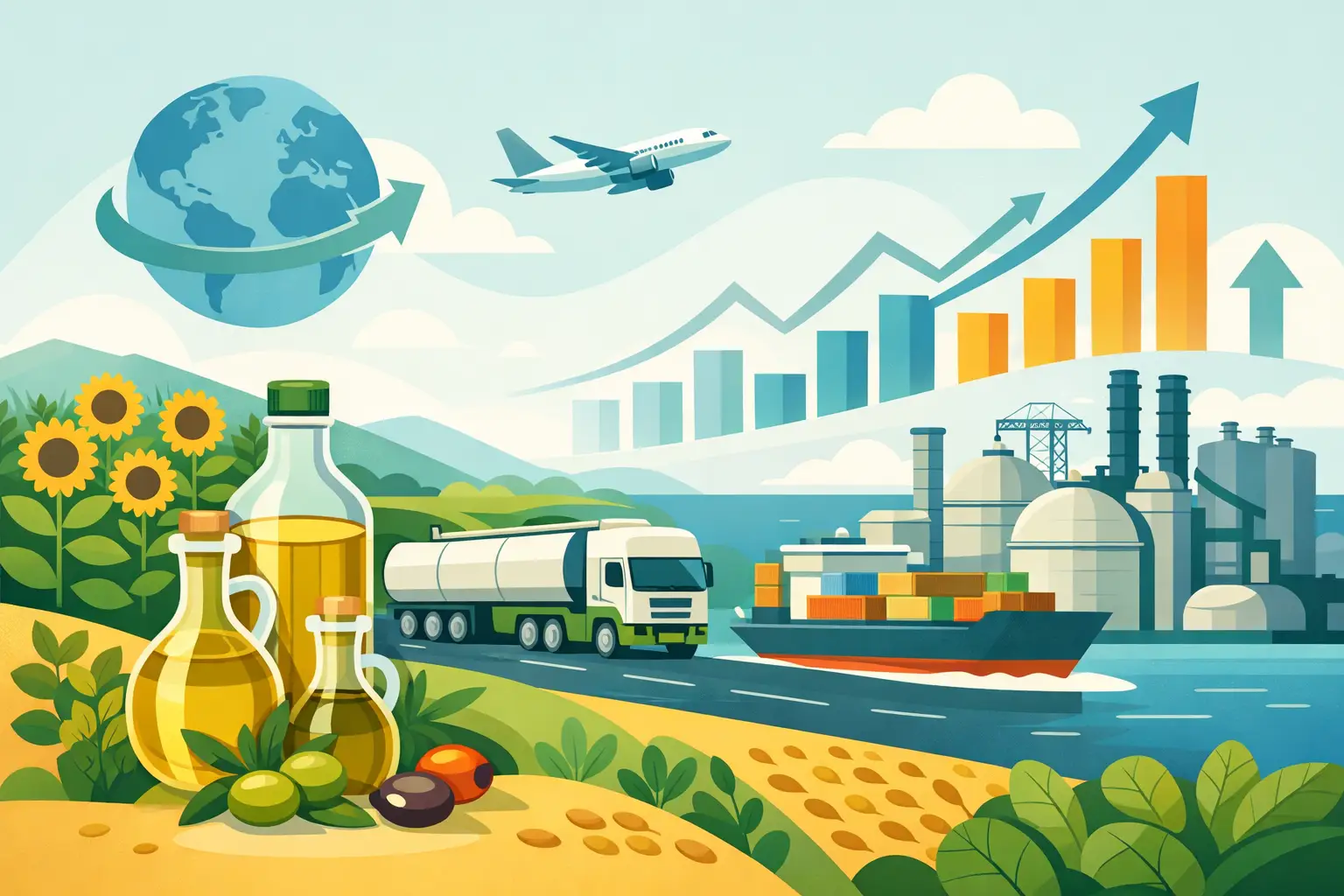
Price is still the first line item most buyers check. It is no longer the only one that decides a contract. The current vegetable oil supply chain trends show a market where freight exposure, origin risk, processing reliability, and documentation standards now shape buying decisions almost as much as the oil itself.
For importers, distributors, and food manufacturers, this shift is practical rather than theoretical. A competitive offer can lose value quickly if lead times move, port conditions tighten, or origin visibility is weak. In edible oils, supply chain performance has become part of product quality.
What is changing in vegetable oil supply chain trends
The main change is that buyers are screening suppliers more closely at the production level. A trader can still fill a role in some deals, especially for spot volumes or blended sourcing strategies, but many procurement teams now want direct manufacturer relationships where possible. That is partly about pricing, but more often it is about predictability.
When the market becomes volatile, buyers need clearer answers on raw material access, refining capacity, packaging capability, and shipping readiness. A producer with real processing operations can usually provide better visibility on these points than an intermediary. That does not remove all risk, but it reduces uncertainty in planning.
Another clear shift is the move from one-dimensional sourcing toward balanced sourcing. Lowest cost still matters. At the same time, buyers are weighing continuity, origin stability, insurance exposure, and substitution flexibility across sunflower, soybean, rapeseed, and palm oil depending on application.
Origin is under closer review
Origin has always mattered in vegetable oils. Now it is reviewed with more discipline. Buyers are asking not just where the oil was shipped from, but where seed supply, processing, and loading are actually anchored.
This matters because origin affects several commercial variables at once. It influences raw material seasonality, crop quality, inland logistics, export routes, documentation practices, and geopolitical exposure. In sunflower oil especially, country of origin remains a major procurement factor because supply concentration can tighten the market quickly when disruptions appear.
For a B2B buyer, origin review is less about branding and more about risk mapping. If one origin offers better crushing capacity but weaker shipping flexibility, while another offers higher freight costs but more stable routing, the right choice depends on the buyer's production schedule and tolerance for delay.
Freight and logistics are now part of the pricing discussion
A few years ago, many buyers treated logistics as a secondary adjustment after product price. That approach is harder to justify now. Freight volatility, equipment availability, and route changes can alter the landed cost materially, especially on bulk or containerized edible oils.
This is one of the more practical vegetable oil supply chain trends because it changes how contracts are evaluated. Buyers increasingly compare not only FOB or CIF numbers, but also the supplier's ability to support realistic shipment schedules. A low headline price is less useful if vessel timing is uncertain or if packing lead times are not aligned with loading windows.
The result is a more operational style of procurement. Teams are asking earlier questions about port options, transit assumptions, packaging format, and contingency planning. In many cases, a slightly higher unit price from a dependable shipper is easier to defend than a lower price that carries avoidable execution risk.
Traceability expectations are rising, even in commodity categories
Vegetable oil is a commodity category, but buyer expectations now go further than basic specification sheets. Traceability, batch control, and documentation discipline are receiving more attention across food manufacturing and commercial distribution.
This does not mean every buyer needs the same depth of reporting. Requirements vary by market, customer segment, and end use. A private-label packer may require more extensive supporting documents than a bulk industrial buyer. Still, the direction is clear. Procurement teams want cleaner information flow from producer to customer.
That includes product specification consistency, certificate availability, lot identification, and clearer visibility into how a supplier manages production and dispatch. Suppliers that treat documentation as part of operations, not as an afterthought, are in a stronger position.
Processing capacity matters more than sales capacity
Another important shift is the growing distinction between companies that sell oil and companies that produce oil. In tight or unstable markets, buyers place greater value on suppliers with actual processing capability, storage infrastructure, and long operating history.
The reason is straightforward. A producer controls more of the chain. That can improve consistency in quality management, availability planning, and communication on lead times. A non-producing seller may still be useful for aggregation or multi-origin sourcing, but for many buyers the producer model offers stronger accountability.
This is especially relevant for repeat contracts. If a customer needs ongoing supply for food manufacturing, continuity matters more than short-term opportunism. Manufacturers with established operations are better positioned to support that need because their commercial commitments are tied to real production assets.
Inventory strategy is becoming more disciplined
The old choice between just-in-time and holding larger safety stock is no longer simple. Buyers are adjusting inventory strategy by product type, route, and customer obligation.
For high-volume edible oils, some businesses are carrying more protection stock than before, but not across every SKU or destination. Others are using mixed contract structures, with a core committed volume and a smaller spot component to manage price movement. This is a more measured response than simply buying extra inventory across the board.
The trade-off is cost. More stock ties up working capital and storage. Less stock leaves a business more exposed to delay or supply shocks. The right balance depends on demand stability, warehouse capacity, and contract penalties downstream.
Substitution and formulation flexibility are influencing sourcing
Food manufacturers are also looking more closely at oil flexibility in formulations. When one category becomes expensive or constrained, procurement and technical teams may revisit whether another vegetable oil can serve the application without compromising product performance.
This does not happen uniformly. Some applications are highly specific, and switching is limited by label requirements, fry performance, flavor profile, or customer standards. In other cases, there is room to adjust between vegetable oils depending on market conditions.
That flexibility affects sourcing strategy. Buyers with formulation options can manage risk more actively. Buyers locked into one oil type need stronger supplier stability and better forward planning.
Supplier evaluation is getting stricter
Commercial buyers are using broader supplier scorecards than they did before. Price remains central, but it sits alongside fulfillment history, communication quality, production credibility, and response speed when conditions change.
This is where experienced manufacturers have an advantage. A supplier that can explain its process clearly, confirm realistic lead times, and maintain product consistency is easier to approve internally. Procurement teams are under pressure to avoid preventable disruptions, so supplier confidence has become a measurable value.
For companies such as EKOBIOTEK, the signal that matters is not promotional language. It is production identity, market experience, and the ability to support ongoing commercial demand from a recognized vegetable oil origin.
What buyers should watch next
The next phase of the market will likely remain uneven. Weather, energy costs, trade policy, freight conditions, and regional conflict can all affect edible oil availability and pricing with little notice. That means buyers should expect continued volatility, but not the same pressure in every oil, route, or contract structure.
The better response is not overreaction. It is tighter supplier selection, clearer contract planning, and better alignment between procurement and logistics. Buyers who understand vegetable oil supply chain trends as an operational issue rather than only a pricing issue will usually make stronger sourcing decisions.
A dependable supply chain is built before the next disruption, not during it. That is where experienced producer relationships still carry the most commercial value.