
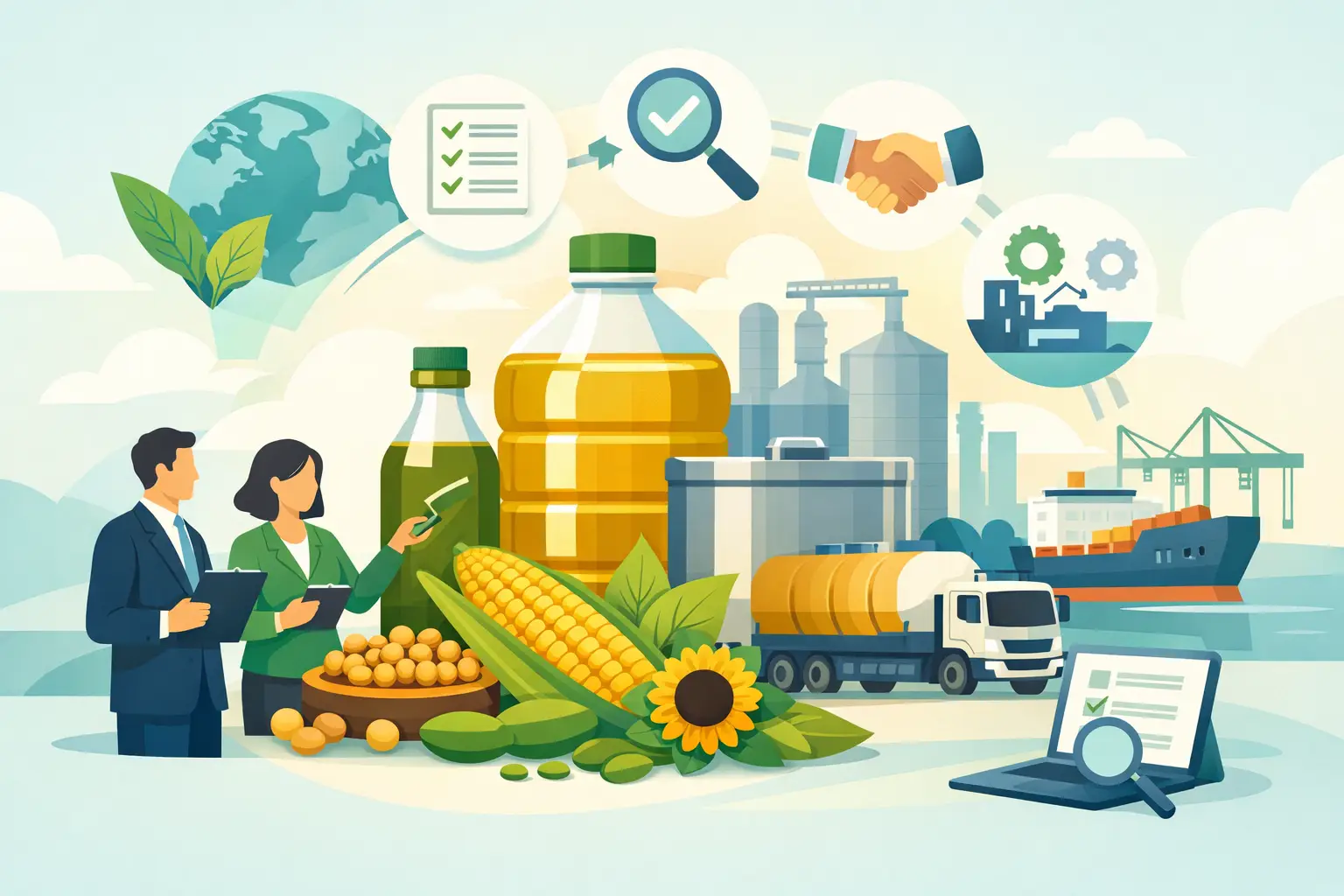
A low price on sunflower, soybean, rapeseed, or blended oil does not establish a dependable supply relationship. For importers and food manufacturers, vegetable oil supplier due diligence must confirm what a supplier can produce, document, ship, and support when market conditions change. A quotation is only the starting point. The commercial risk sits behind it: raw material access, processing capability, quality controls, export documentation, and contractual accountability.
The review should be proportionate to the order value and the intended use of the oil. A one-time container purchase requires less investigation than a recurring food-production program, but both require evidence that the supplier is a real operating business with control over the product offered.
Start With the Supplier’s Operating Identity
First establish whether the counterparty is a producer, a trader, or an agent. Each model can have a place in a supply program, but buyers should understand who controls manufacturing, inventory, specifications, and shipment release. A trader may provide useful market access and flexible sourcing. It may also add another layer between the buyer and the plant.
Ask for the legal company name, registration details, physical production address, tax and export information where applicable, and the names of authorized commercial contacts. These details should match across the quotation, contract draft, invoice, bank account information, and product documents. A mismatch does not automatically indicate misconduct, but it requires a clear explanation before payment is made.
For a manufacturer, verify the operating history and the facility’s relationship to the selling entity. Long-term production experience matters because edible oil supply depends on established procurement, refining, storage, laboratory, and logistics practices. A supplier should be able to describe its role in the chain without vague statements about access to product.
Vegetable Oil Supplier Due Diligence at the Plant Level
A supplier’s stated annual capacity is less useful than its available capacity during your required shipping window. Plants may have significant nameplate capacity while facing limited seed availability, scheduled maintenance, restricted storage, or existing contract commitments. Ask what volume can be allocated to your program, over what period, and in which packaging formats.
The assessment should cover the practical production chain: oilseed sourcing, crushing or refining operations, deodorization where relevant, storage tank capacity, filtration, filling lines, and loading arrangements. For crude oil, the review will focus more heavily on extraction, storage, and cargo handling. For refined, bleached, and deodorized oil, refining parameters and finished-product controls carry greater weight.
A remote audit can provide an initial review, particularly when travel is impractical. It should include a live walk-through of the facility, tanks, laboratory, packaging area, warehouse, and loading point. For long-term or high-value programs, an independent inspection or in-person audit is generally justified. The goal is not to demand unnecessary disclosure. It is to confirm that the offered product can be produced and dispatched under controlled conditions.
For Ukrainian-origin sunflower oil, buyers should also review the supplier’s current transport routes, port or border options, storage locations, and contingency plans. Country origin can be a commercial strength, but route availability and lead times must be assessed based on current conditions rather than historic assumptions.
Match Specifications to the Intended Application
“Sunflower oil” is not a complete specification. The required product profile depends on whether the oil will be used for bottling, frying, bakery production, sauces, margarine, animal feed, or further processing. A supplier should provide a current specification sheet that states the product type, origin where relevant, physical and chemical parameters, packaging, shelf life, and storage conditions.
Typical quality points include free fatty acids, peroxide value, moisture and volatile matter, insoluble impurities, phosphorus, color, odor and taste, fatty acid profile, and trans-fat status. The applicable limits depend on the oil grade and the buyer’s market requirements. Buyers should not rely solely on a generic certificate from a previous shipment. Request a representative certificate of analysis and define the agreed testing method in the contract.
For refined edible oils, confirm whether the product meets the relevant food safety and labeling requirements for the destination market. If the oil will enter the United States, the importer must also ensure that its own import, food safety, and supplier-verification obligations are addressed. A supplier can support this process with documents, but responsibility cannot be assumed to transfer automatically through a commercial agreement.
Allergen management, GMO status, organic claims, non-GMO claims, kosher status, halal status, and sustainability claims should be handled carefully. These claims may be essential for a specific customer program, but they should only appear in specifications and labels when supported by current, traceable documentation. A broad marketing statement is not enough for a regulated or private-label application.
Review Food Safety Controls and Traceability
The buyer should understand how the supplier controls food safety from incoming oilseeds or crude oil through final loading. Relevant evidence may include food safety certifications, hazard-control procedures, sanitation records, laboratory testing protocols, pest-control programs, recall procedures, and traceability records. Certification is useful, but it should not replace questions about how controls operate in practice.
Traceability is especially important in bulk supply. The supplier should be able to connect a shipped lot to production dates, storage tanks, refining batches, test results, and loading records. This allows the buyer to investigate a quality issue without uncertainty over which material was affected.
Retention samples should be addressed before the first shipment. Agree on how samples will be taken, sealed, labeled, retained, and made available in the event of a claim. Independent pre-shipment inspection may be appropriate for new suppliers, high-risk routes, or contracts where quality parameters have narrow tolerances.
Test Commercial and Financial Reliability
A capable plant can still be a difficult counterparty if its commercial processes are weak. Review the supplier’s ability to issue consistent documents, respond to claims, manage export paperwork, and meet agreed shipment schedules. Reference checks with established customers can be useful where available, especially for recurring contracts.
Payment terms should reflect the transaction risk. Full advance payment offers the buyer the least protection unless there is an established relationship and strong evidence of supplier performance. Letters of credit, documentary collections, staged payments, escrow arrangements, or payment against inspected documents may be more suitable depending on deal size, country risk, and the parties’ banking capabilities.
Check that the beneficiary name and bank account details are consistent with the contracted seller. Any late change to payment instructions should be independently verified through a known contact, not only through an email reply. Procurement controls in this area prevent both fraud and costly administrative errors.
Sanctions screening, beneficial ownership review, and restricted-party checks are also necessary for cross-border trade. Requirements vary by jurisdiction and product route. Buyers should use their internal compliance process and obtain legal guidance where the transaction presents elevated risk.
Put the Evidence Into the Contract
Due diligence has limited value if the purchase contract leaves critical points open. The agreement should identify the product grade, agreed specifications, quantity tolerance, packaging, Incoterms rule and named location, shipment period, required documents, payment method, inspection process, and claim procedure.
Quality claims require particular precision. State where sampling occurs, which laboratory has authority if results differ, what methods apply, and how a nonconforming cargo will be handled. Include timelines for notifying claims and define whether remedies may include a price adjustment, replacement, rejection, or another agreed solution.
Force majeure and delay provisions should be realistic. They should distinguish between a genuine event outside a supplier’s control and routine operational problems such as missed booking, inadequate packaging, or failure to secure product. A supplier should communicate potential disruption early enough for the buyer to protect production schedules.
Treat Due Diligence as an Ongoing Control
Supplier approval is not a one-time document collection exercise. Oilseed harvests, crop quality, freight capacity, regulations, exchange rates, and regional transport conditions can all change the reliability of a supply program. Review performance after each shipment: conformity of documents, quality results, loading dates, quantity accuracy, communication, and claim handling.
EKOBIOTEK approaches buyer discussions from the position of a specialized Ukrainian vegetable oil producer, with manufacturing experience dating to 2003. For buyers, the useful question is always the same: can the supplier provide current evidence that supports the volume, grade, and delivery commitment being offered?
A disciplined review does not eliminate commodity-market risk. It gives procurement teams a clearer basis for choosing which risks can be priced, which can be contracted, and which require a different supplier or shipment plan. The best time to resolve those questions is before the purchase order becomes a production dependency.