
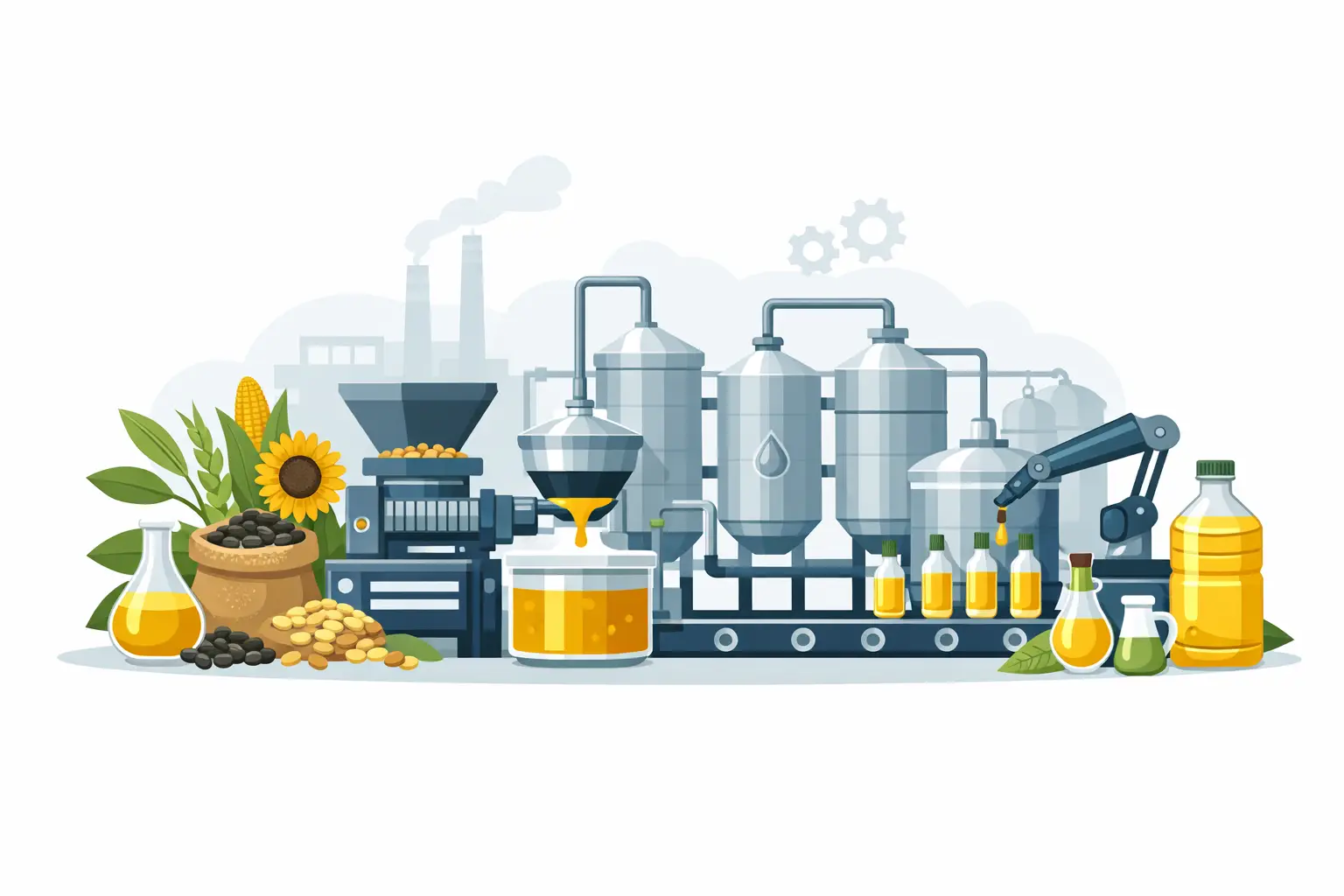
For procurement teams, the vegetable oil manufacturing process is not a technical side topic. It directly affects product consistency, shelf life, specification control, and supply reliability. If you are buying sunflower oil or other edible vegetable oils in bulk, understanding how the oil is produced helps you assess a manufacturer’s capability, not just its price.
The process begins long before oil enters a tank truck or export container. It starts with raw material quality, plant discipline, and the manufacturer’s ability to keep output stable across batches. In practical terms, that means the value of a supplier is tied to how well each production stage is managed.
What the vegetable oil manufacturing process includes
At an industrial level, the vegetable oil manufacturing process usually covers seed intake, cleaning, preparation, oil extraction, filtration or refining, storage, and filling for bulk shipment. The exact sequence depends on the oil type, the intended end use, and the buyer’s specification.
Sunflower oil is a useful example because it is one of the most important edible oils in global trade and a category strongly associated with Ukrainian agriculture. For this product, the difference between acceptable output and dependable commercial-grade output often comes down to process control. A supplier may have access to raw seeds, but that alone does not guarantee stable oil quality.
Raw material intake sets the baseline
Every edible oil plant starts with incoming agricultural raw materials. For sunflower oil, this means seeds are evaluated for moisture, impurity level, oil content, and overall condition. Poor seed quality can reduce yield, complicate extraction, and create downstream refining problems.
This is one reason experienced manufacturers put strong controls at intake. If seeds arrive with excessive foreign matter, high moisture, or storage damage, the oil may require more correction later. That increases processing load and can affect cost efficiency. Buyers may not see this stage, but they see the result in consistency, color, odor, and specification compliance.
Cleaning and seed preparation
Before extraction, seeds are cleaned to remove dust, stones, metal, husk fragments, and other foreign material. This stage protects equipment and improves process efficiency. In industrial production, cleaning is not optional. It is part of maintaining throughput and reducing contamination risk.
After cleaning, the raw material is prepared for oil recovery. Depending on the plant setup and seed type, this may involve dehulling, crushing, flaking, and heat conditioning. These steps are designed to make oil release more efficient during pressing or solvent extraction.
Preparation has a direct commercial impact. When done correctly, it improves extraction yield and supports more uniform output. When done poorly, the plant may lose recoverable oil and create unnecessary variation from batch to batch.
Extraction in the vegetable oil manufacturing process
The main extraction stage generally follows one of two industrial routes: mechanical pressing or solvent extraction. Some manufacturers use a combination, especially when they want to maximize oil recovery.
Mechanical pressing uses physical force to separate oil from prepared seed material. This method is widely used and is straightforward from an operational standpoint, though it may leave more residual oil in the meal than solvent-based systems. It can be suitable where the target is a simpler process flow or a certain product positioning.
Solvent extraction is used when higher recovery rates are required. In this system, a solvent separates more oil from the prepared material, after which the solvent is removed and recovered through controlled processing. This approach typically improves yield, but it also demands stricter technical management, safety controls, and process discipline.
For buyers, the key point is that extraction method influences both economics and final product pathway. Higher recovery can improve production efficiency, but the value depends on how well the manufacturer manages the full system afterward.
Crude oil handling and initial filtration
Once oil is extracted, it is typically considered crude oil. At this stage, it still contains natural impurities such as phospholipids, free fatty acids, pigments, waxes, trace metals, and suspended solids. Crude oil is not automatically ready for food industry use, particularly where buyers require refined specifications.
Initial settling and filtration remove coarse particles and improve the oil’s condition before refining. This stage matters because unstable crude oil handling can create oxidation issues or reduce refining efficiency later. Time, temperature, and storage conditions all play a role.
A serious producer treats crude oil management as part of quality control, not just as a transfer step between departments.
Refining for food-grade specifications
Refining is the stage that brings crude vegetable oil closer to the standards expected in food manufacturing, distribution, and export markets. Not every customer requires the same degree of refining, but most commercial edible oil buyers expect a clear, stable, food-grade product that meets agreed specifications.
Refining generally includes degumming, neutralization, bleaching, and deodorization. Degumming removes phospholipids and related compounds. Neutralization reduces free fatty acids. Bleaching improves color and removes certain impurities. Deodorization uses controlled heat and vacuum conditions to remove volatile components that affect taste and odor.
There is no single refining profile that fits every contract. It depends on the intended application, local market requirements, and product grade. A food manufacturer may focus heavily on stability and sensory neutrality, while another buyer may prioritize a specification tied to further downstream processing. The manufacturer must be able to match the refining approach to the commercial requirement.
Winterization and application-specific treatment
For some vegetable oils, additional processing may be required after standard refining. In sunflower oil, winterization can be relevant where clarity at lower temperatures is important. This step removes waxes that can cause cloudiness during cold storage or distribution.
Whether this stage is necessary depends on market expectations and end use. Not every buyer needs the same treatment, which is why clear specification alignment matters early in supplier discussions. A capable manufacturer should be able to explain which process steps are standard and which are application-dependent.
Quality control is built into the process
In edible oil supply, quality control is not a final inspection alone. It should run across intake, processing, storage, and dispatch. Typical control points include moisture, impurity levels, acid value, peroxide value, color, odor, and other physical and chemical indicators relevant to the product specification.
For B2B buyers, this is where manufacturing credibility becomes visible. A supplier with process discipline can produce repeatable results. A supplier without it may still ship product, but consistency becomes uncertain over time.
This is particularly important in international trade, where buyers often need confidence not only in one shipment, but in continuity over repeated orders. Long-term supply relationships depend on stable output more than on occasional spot availability.
Storage, filling, and bulk shipment
After processing, oil is stored in controlled tanks before dispatch. Storage conditions matter because edible oils can degrade if exposed to excess heat, air, or contamination. Proper tank management helps preserve product quality until loading.
The final stage includes bulk filling and shipment according to the customer’s logistics format. Depending on the transaction, this may involve tanker loading, flexitanks, drums, or other commercial packaging formats. The packaging decision is not separate from manufacturing. It affects handling efficiency, transit protection, and delivery suitability for the buyer’s operation.
A manufacturer serving wholesale and industrial buyers must align production with dispatch capability. Reliable supply is not only about making oil. It is also about loading the correct product, in the correct format, with the correct documents and timing.
Why this process matters when selecting a supplier
For commercial buyers, the vegetable oil manufacturing process is a practical indicator of supplier strength. It shows whether a company is functioning as a real producer with technical control or simply participating in trade flows without production depth.
That distinction matters when markets tighten, raw material costs shift, or buyers need continuity across multiple shipments. Manufacturers with an established process base are generally better positioned to manage quality variation, maintain output discipline, and support long-term supply programs. For companies such as EKOBIOTEK, production history and specialization in vegetable oils are part of that credibility.
Price will always matter, but procurement decisions in edible oils are rarely about price alone. The more closely a buyer understands the manufacturing process, the easier it becomes to evaluate consistency, risk, and supplier fit. That usually leads to better sourcing decisions and fewer problems after the contract is signed.
A useful next step is to ask not only what oil is being offered, but how the plant produces it, controls it, and keeps that standard over time.