

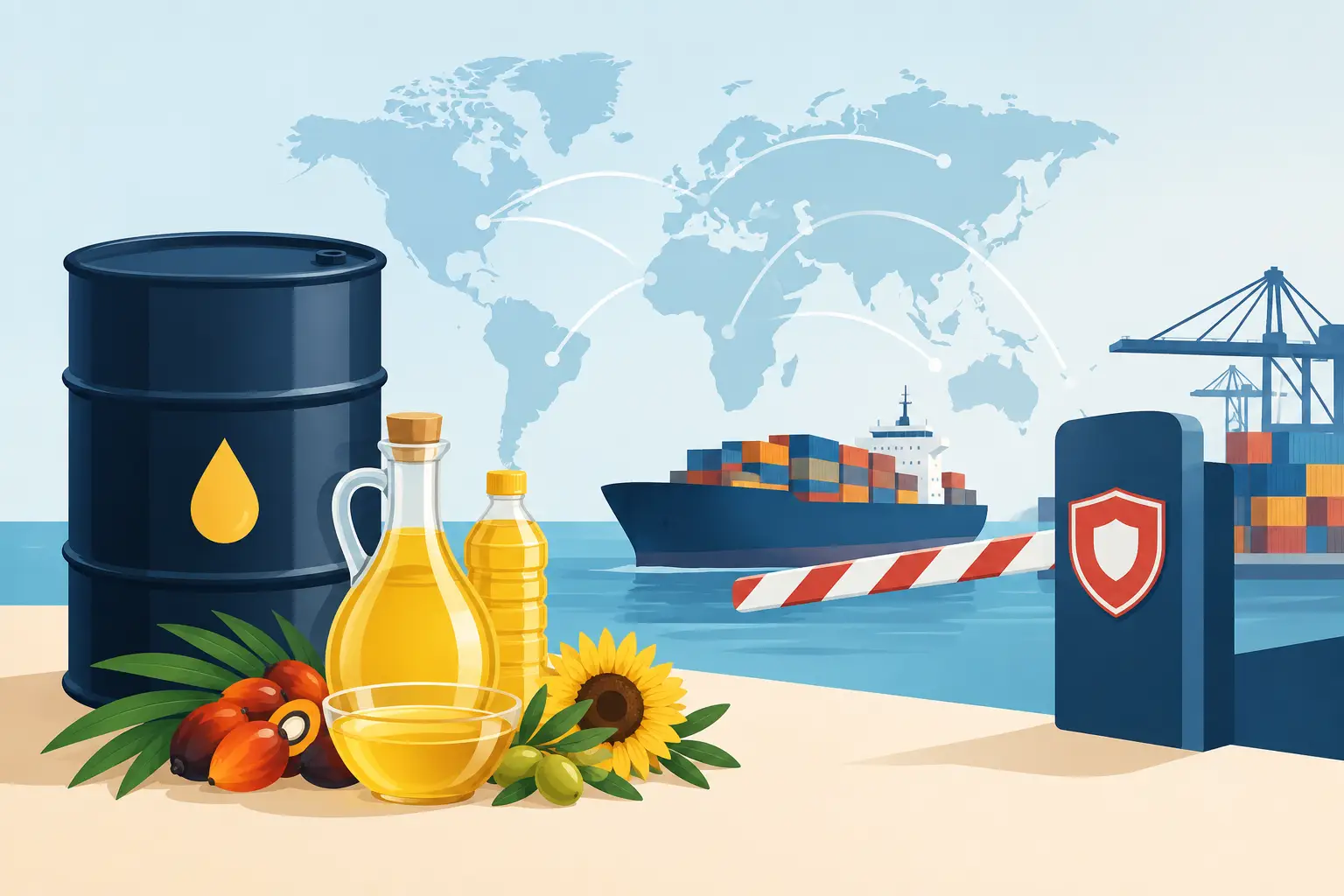
A quoted price for crude or refined sunflower oil is only one part of the purchase cost. Oil tariffs, customs duties, trade remedies, port charges, inland freight, and financing costs can all change the final landed value of a shipment. For importers and food manufacturers, the relevant question is not simply which supplier offers the lowest ex-works or FOB price. It is which supply program produces the most reliable delivered cost under the applicable trade rules.
Edible oil trade is particularly sensitive to these changes because margins can be narrow, volumes are large, and procurement commitments often extend beyond a single shipment. A duty change of a few percentage points can affect contract competitiveness, packaging decisions, inventory timing, and the choice between origins.
What Oil Tariffs Mean for Commercial Buyers
Oil tariffs are taxes or duties imposed on imported oil products. They may apply to crude vegetable oils, refined oils, blended oils, or finished food products containing oil. The rate and treatment depend on the importing country, the product classification, its degree of processing, country of origin, and any trade agreements or trade measures in force at the time of entry.
For a U.S. buyer, customs treatment begins with the correct classification under the Harmonized Tariff Schedule. Sunflower oil, for example, can be treated differently depending on whether it is crude or refined, bulk or packaged, and whether it has been mixed with other products. The tariff classification should be confirmed before a purchase order is issued, not after cargo is loaded.
Ordinary customs duty is not the only exposure. In some cases, imports may also face antidumping duties, countervailing duties, safeguard measures, or country-specific additional duties. These measures are separate from a standard tariff and can materially change the landed cost. Their application is highly product- and origin-specific, so buyers should avoid relying on general market assumptions.
Why Tariffs Change the Real Cost of Edible Oil
A tariff is calculated on the customs value of the goods, but its commercial effect reaches further. When the duty increases the cash required at import, it raises working-capital needs. If a buyer holds inventory for several months, the cost of carrying that higher-value inventory also rises. The impact is more pronounced in bulk purchases and container programs where payment, ocean transit, customs clearance, and warehouse receipt occur across a long period.
A basic landed-cost model should include the product price, international freight, marine insurance where applicable, customs value, duties and other import charges, brokerage, port costs, domestic transport, storage, inspection, and financing. The duty rate should not be treated as an isolated percentage. It needs to be modeled against the value basis used for customs purposes and the expected arrival date.
Timing matters. A purchase contract may be signed under one tariff environment while the shipment arrives after a policy change. Unless the contract clearly allocates that risk, the importer of record may carry the added cost. For this reason, procurement teams should distinguish between a price that is fixed at origin and a delivered price that remains exposed to border charges.
Product Form Can Affect Duty Exposure
Processing level can influence classification and duty treatment. Crude sunflower oil, refined sunflower oil, deodorized oil, bottled retail oil, and blended vegetable oils may not fall under the same tariff provisions. Packaging may also affect classification and logistics costs, even when it does not change the underlying product category.
This creates a practical sourcing decision. A buyer may import bulk oil for domestic bottling, or import finished packaged goods. The right option depends on tariff treatment, labor and packaging capacity, lead times, quality-control requirements, and the economics of domestic distribution. A lower duty on one product form does not automatically make it the lower-cost option after packaging, handling, and inventory requirements are considered.
Origin Is a Procurement Variable, Not a Label
Country of origin is central to tariff assessment. It is generally determined by customs rules, not by the shipping port or the seller's location. Moving cargo through a third country does not normally change origin. Buyers should request complete and accurate origin documentation and confirm that product records support the declared origin.
For sunflower oil, origin also carries supply-chain significance. Ukraine has long been a major agricultural producer and an important source of sunflower seed and oil. Buyers evaluating Ukrainian supply should assess more than price and customs treatment. They should review production capacity, raw material availability, export routing, transit time, payment structure, and contingency options for logistics disruptions.
An established producer can provide useful clarity in this process by documenting product specifications, production location, origin, and shipment terms consistently. EKOBIOTEK, operating from Kherson with a production history dating to 2003, represents the type of specialized supplier relationship that can support more disciplined planning for bulk sunflower and vegetable oil purchases.
Managing Oil Tariffs in Supply Contracts
Tariff exposure should be addressed during commercial negotiation. In a standard import transaction, the named Incoterm determines where responsibilities for transport and delivery transfer, but it does not remove the need to define customs responsibilities clearly. Buyers should know who acts as importer of record, who prepares customs documentation, and who bears the cost if duties or trade measures change before entry.
Contract language should also identify the product in commercially and technically precise terms. A vague description such as “vegetable oil” can create avoidable uncertainty when classification depends on refining status, composition, packaging, or intended use. Specifications should align with invoices, packing lists, certificates, and customs declarations.
For recurring supply programs, buyers may use a tariff-change clause. The structure varies, but the purpose is straightforward: state whether the agreed price includes known duties and how an unexpected government-imposed charge will be handled. Some buyers accept the risk in exchange for a lower base price. Others prefer a delivered-cost structure with more visibility, even if the initial quotation is higher. The suitable approach depends on shipment frequency, volume, market volatility, and each party's ability to absorb cost changes.
A Practical Review Before Placing an Order
Before confirming an edible oil purchase, procurement teams should validate four connected points: the exact product description, the tariff classification, the documented origin, and the expected date of customs entry. These facts determine whether a quoted duty assumption is usable.
The review should involve the customs broker or trade compliance team early enough to correct documentation before loading. It should also be repeated when the product format changes, a new origin is introduced, or trade policy shifts. A classification used for one shipment is not a permanent answer for every future shipment.
Buyers should also keep supplier documentation organized. Commercial invoices, certificates of origin where required, bills of lading, product specifications, refining statements, and packing details must be consistent. Documentation gaps can delay release, create valuation questions, or lead to duty reassessments after import.
Avoiding False Savings
A low offer can become expensive when tariff assumptions are incomplete. This is common when quotes compare origin prices without accounting for customs charges, demurrage risk, domestic transport, or the cost of delayed production. It can also occur when a buyer selects a supplier solely on the basis of a temporary duty advantage without considering continuity of supply.
The stronger approach is to compare suppliers on a like-for-like landed basis. Use the same quantity, quality specification, Incoterm, destination, expected entry date, and payment terms. Then test the model against a reasonable duty change or freight increase. This does not eliminate uncertainty, but it shows which supply option remains workable when conditions move.
For edible oil buyers, tariffs are not a separate compliance issue to be reviewed after sourcing. They are part of the purchasing decision itself. A current classification review, accurate origin records, and a contract that assigns border-cost risk clearly give procurement teams a firmer basis for maintaining supply when market conditions change.