
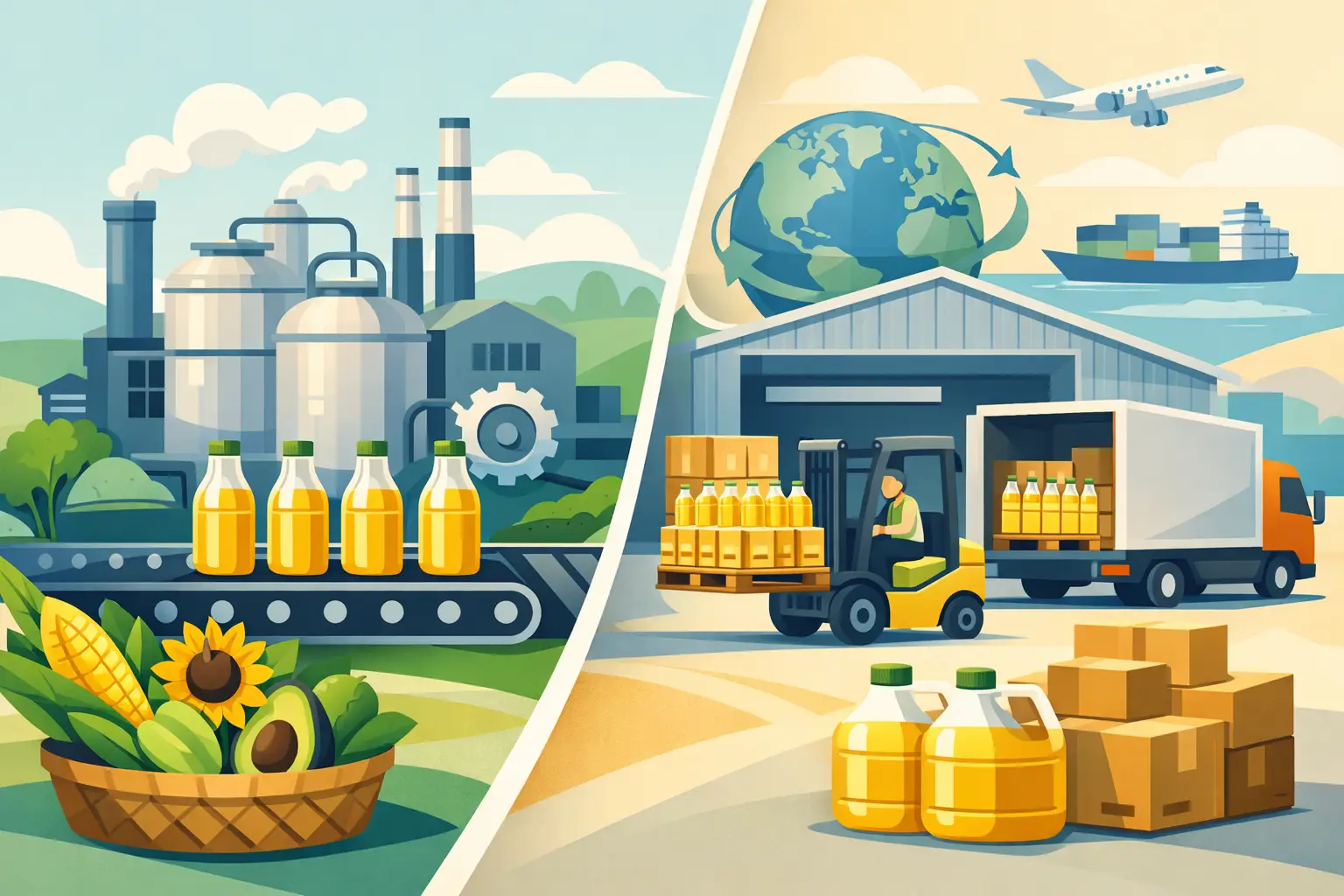
When procurement teams compare manufacturer vs distributor vegetable oil sourcing, the real issue is not terminology. It is control. The choice affects price structure, product consistency, lead times, documentation flow, and how quickly problems are resolved when market conditions tighten.
For bulk buyers, both models can work. A distributor can simplify purchasing, especially when mixed loads, small volumes, or local inventory matter most. A manufacturer can offer direct visibility into production capability, origin, and quality management. The right choice depends on what you are buying, how often you buy it, and how much supply risk your business can absorb.
Manufacturer vs distributor vegetable oil: what changes for the buyer
A manufacturer produces the oil. That means the supplier controls processing, production planning, and often packaging options tied to the plant. In vegetable oils, this matters because production capability is directly connected to raw material sourcing, refining parameters, batch consistency, and commercial scale.
A distributor does not usually produce the oil. The distributor buys from one or more producers and resells to downstream customers. In some cases, the distributor adds value through warehousing, inventory availability, freight coordination, or market access in a specific region. For many buyers, that service has clear value. But the commercial relationship is different because the seller is an intermediary rather than the production source.
This distinction becomes more important in edible oils than in some other categories. Vegetable oil is a high-volume, specification-sensitive product. Small differences in origin, refining process, packaging configuration, and shipment timing can affect manufacturing schedules and margins for the buyer.
Pricing is not just about the invoice
The most common assumption is that buying direct from a manufacturer always means a lower price. Often that is true, but not in every case.
A manufacturer removes one commercial layer from the chain. For buyers purchasing regular bulk volumes, that can improve price competitiveness because there is no distributor margin added on top of producer pricing. Direct sourcing can also create better visibility into why prices move, especially when raw material costs, seasonal availability, freight conditions, or export market pressure affect sunflower oil and other vegetable oils.
At the same time, a distributor may still offer better practical economics for some accounts. If your order size is below a manufacturer’s preferred production or shipping threshold, the distributor may be able to consolidate volume from several producers and offer a workable delivered cost. The invoice may look higher per unit, but the total procurement cost can still make sense if the alternative is buying more than you need, carrying excess inventory, or arranging separate logistics.
For procurement, the better question is not who has the lowest nominal price. It is who offers the lowest total cost for your order pattern.
Quality control and specification accountability
Quality discussions become sharper when buyers look at accountability. With a manufacturer, the source of responsibility is more direct. If a specification issue appears, the conversation starts with the party that ran the production process. That usually shortens technical review because there is less distance between the buyer and the production records.
This matters for refined vegetable oils, where consistency is tied to the plant’s operating standards, quality systems, and experience in the product category. Buyers that need repeatability from shipment to shipment often prefer direct manufacturer relationships for this reason. There is a clearer link between the specification sheet and the actual production environment.
A distributor can still provide compliant product and good technical service, especially when working with established manufacturing partners. But if the distributor is sourcing from multiple producers, consistency can vary unless specifications and supplier controls are tightly managed. For a buyer, that adds another point to verify. The question is no longer only whether the oil meets the requirement today. It is whether the same standard will be maintained across future lots and future source plants.
Lead times and supply continuity
Lead time is another area where the answer depends on your business model. A distributor can be faster when local stock is already in place. If you need prompt domestic delivery from inventory, a distributor may be the stronger option.
A manufacturer is often stronger on planned supply continuity. For recurring contracts, forecasted demand, or container and bulk export programs, direct production access gives the buyer a clearer view of available capacity and scheduling. That becomes especially important when markets tighten and supply becomes less predictable.
In volatile commodity categories, buyers do not only need product. They need confidence that the supplier can continue shipping under pressure. An experienced producer with a defined manufacturing base and category specialization can provide a different level of sourcing stability than a trader working from available market positions.
This is where producer identity matters. A company such as EKOBIOTEK, operating as a vegetable oil manufacturer with a long production history in Ukraine, signals direct involvement in the supply side of the market rather than reliance on third-party sourcing alone.
Documentation, traceability, and communication flow
For importers and industrial buyers, commercial efficiency is not limited to price and product. It also includes documents, approvals, and response time.
Buying from a manufacturer can improve clarity in documentation because the supplier has direct access to production, quality, and shipment information. Certificates, technical data, and origin-related documents are typically handled closer to the source. That can reduce delays when your internal compliance or customs process needs prompt confirmation.
With a distributor, the process can still be efficient, but communication may pass through one more layer. When questions are simple, that may not matter. When questions concern batch details, production timing, or technical deviations, one additional step can slow decision-making.
For procurement teams managing multiple international suppliers, that difference becomes significant over time. The smoother the information flow, the lower the administrative friction tied to every purchase order.
Order size often decides the right model
The manufacturer vs distributor vegetable oil decision is often settled by volume.
Large buyers with repeat requirements usually benefit from direct manufacturer engagement. The scale supports factory-oriented pricing, better production planning, and a more stable long-term commercial structure. This is especially true for importers, food manufacturers, private-label programs, and bulk commodity buyers that need predictable supply rather than spot-market convenience.
Smaller buyers or buyers with irregular demand may be better served by distributors. If your purchasing pattern changes month to month, or if you need mixed products in lower quantities, a distributor may offer flexibility that a production plant is less interested in providing.
That is not a question of quality. It is a question of fit. Manufacturers tend to be strongest when volume, frequency, and specification discipline justify a direct relationship.
When a distributor is the better choice
Distributors are not simply a more expensive version of a manufacturer. In the right context, they solve real procurement problems.
They can support regional availability, smaller minimums, faster fulfillment from stock, and multi-line purchasing across categories. For buyers who want one supplier relationship across several products, a distributor can reduce complexity. They can also be useful when entering a new market or testing a product before committing to direct supply volumes.
If your business values convenience more than production-level visibility, a distributor may be the efficient option. The premium you pay may be justified by reduced coordination and easier short-term purchasing.
When direct from the manufacturer makes more sense
If vegetable oil is a core input for your business, direct sourcing becomes more attractive. The more material you buy, the more important manufacturing control becomes.
A direct producer relationship generally offers stronger footing on consistency, origin confidence, technical accountability, and long-range planning. It also gives the buyer a clearer commercial basis for negotiating ongoing supply rather than reacting to reseller availability.
This matters most for buyers that cannot afford interruptions or unexplained variability. Food manufacturers, importers, and wholesale programs usually need more than product access. They need a supplier that is structurally connected to production.
The practical question to ask before you buy
Instead of asking whether a manufacturer or distributor is better in general, ask what your business actually needs from the relationship. If you need small lots, local stock, and broad product coverage, a distributor may fit. If you need stable bulk supply, direct accountability, and confidence in the production source, a manufacturer is often the better commercial choice.
In vegetable oils, sourcing decisions are rarely about labels alone. They are about how close you need to be to the source of supply when price, quality, and continuity all matter at the same time.
The strongest buying decision usually comes from matching your order pattern to the supplier model, then choosing the partner that can keep delivering when the market stops being easy.