
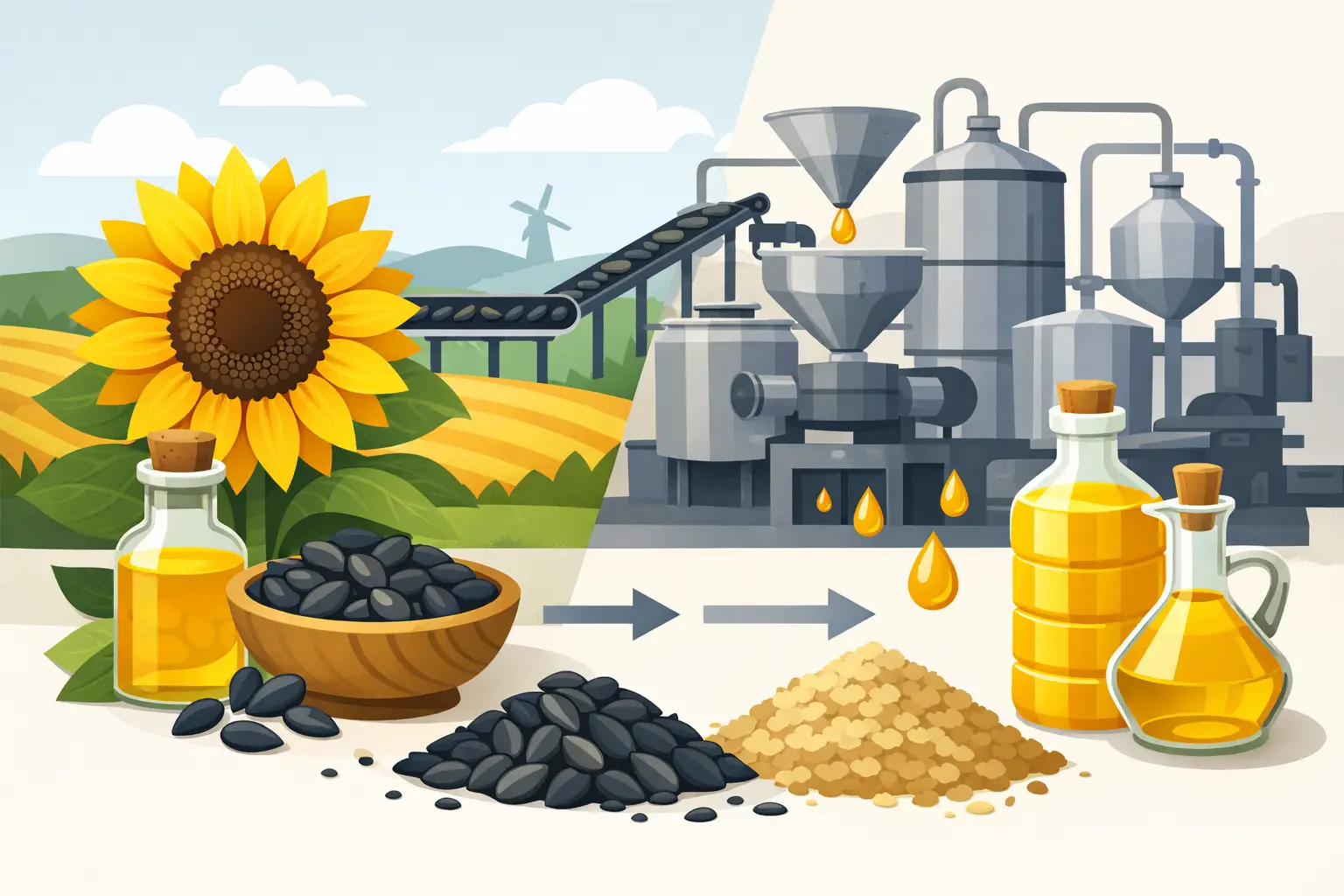
Procurement teams hear the question often: is sunflower oil highly processed, and does that matter for food manufacturing? The short answer is that it depends on the oil type, the intended application, and the production standard behind it. Sunflower oil is a processed agricultural product, but that does not make every sunflower oil excessively processed or unsuitable for commercial food use.
For B2B buyers, the better question is not whether processing exists. It is which processing steps are used, why they are used, and how those steps affect stability, flavor, appearance, and performance in the final application. In edible oils, processing is not automatically a negative. In many cases, it is what makes the product consistent, safe, and commercially practical at scale.
What "highly processed" means in edible oils
The phrase "highly processed" is often used loosely. In consumer discussions, it can imply that a product is far removed from its raw agricultural source. In industrial food production, the term needs more precision.
Sunflower oil begins with sunflower seeds. Oil is obtained either through pressing alone or through a combination of mechanical extraction and further refining. Once extracted, crude oil contains natural impurities such as phospholipids, free fatty acids, waxes, pigments, trace metals, and suspended particles. These components can affect shelf life, smoke point, taste, and appearance.
If an oil goes through multiple technical steps to remove those elements and standardize performance, some people will call it highly processed. From a manufacturing perspective, those steps are better understood as refining operations. They are designed to produce an oil that meets food industry requirements for clarity, stability, neutrality, and consistency.
Is sunflower oil highly processed in all cases?
No. Sunflower oil exists on a spectrum.
Cold-pressed sunflower oil is typically less processed. It is mechanically extracted and may undergo only limited filtration. It usually retains more of its original flavor, aroma, and color. That can be desirable in niche retail or specialty food applications, but it may also result in lower oxidative stability, more flavor impact, and greater variability between batches.
Refined sunflower oil undergoes additional processing steps after extraction. This is the format most commonly used in large-scale food manufacturing, foodservice, and international trade. It is more neutral in flavor, lighter in color, and more stable in storage and cooking environments.
So if the question is "is sunflower oil highly processed," the accurate answer is that some sunflower oils are minimally processed while others are fully refined for commercial performance. The category is not uniform.
How refined sunflower oil is produced
For commercial buyers, the production sequence matters more than the label. A refined sunflower oil may pass through several standard stages.
Extraction
The first stage is oil recovery from the seed. This may be done through mechanical pressing, solvent extraction, or a combination of both, depending on plant design, target yield, and product specification. Crude oil at this stage is usable only as an intermediate product. It is not yet optimized for most food applications.
Degumming
Degumming removes phospholipids and mucilaginous materials. These compounds can create instability and handling issues. Their removal improves further refining efficiency and helps prepare the oil for downstream processing.
Neutralization
Neutralization reduces free fatty acids, which can contribute to off-flavor development and lower stability. This step helps improve the oil's storage behavior and supports standard product quality.
Bleaching
Bleaching removes pigments and trace contaminants through adsorbent materials. This is mainly a purification step, not a cosmetic one. It contributes to color consistency and can reduce components that accelerate oxidation.
Deodorization
Deodorization uses controlled heat and vacuum to remove volatile compounds responsible for odor and flavor. This is one of the key reasons refined sunflower oil performs well in applications where a neutral taste profile is required.
Winterization, when required
Some sunflower oils may undergo winterization or dewaxing to remove waxes that can cause cloudiness at lower temperatures. This matters in bottled oil presentation and in applications where visual clarity is part of the specification.
These are standard edible oil operations. They are not unusual, and they are not unique to sunflower oil. Similar refining logic applies across many vegetable oil categories.
Why processing is often necessary
In commercial food production, consistency is not optional. Buyers need an oil that behaves predictably in frying, baking, snack production, sauce manufacturing, and private-label packaging. Crude or lightly filtered oil can vary too much for those uses.
Processing helps solve practical problems. It extends shelf life by reducing unstable compounds. It improves sensory neutrality, which matters when the oil should not affect the flavor of the finished product. It increases clarity and visual consistency. It also supports compliance with defined quality parameters used in international trade and food manufacturing.
This is the central trade-off. Less processed oil may appeal in specialty segments because it is closer to the raw seed. More refined oil usually offers stronger operational advantages for scale, storage, logistics, and repeated use under heat.
Does refining remove nutrients?
Yes, some naturally occurring minor compounds can be reduced during refining. Depending on the process, certain tocopherols, pigments, and aromatic compounds may decline. This is one reason cold-pressed oils are often marketed for their more natural sensory profile.
At the same time, buyers should separate nutritional marketing claims from functional purchasing decisions. In many commercial applications, the priority is not preserving every native compound. The priority is obtaining a food-grade oil with stable composition, acceptable shelf life, and reliable performance under industrial conditions.
That is why refined sunflower oil remains a standard choice in broad segments of the edible oil market.
Is refined sunflower oil a lower-quality product?
Not necessarily. Refining and quality are not opposites.
Low-quality oil can be poorly refined, and high-quality oil can be carefully refined. What matters is the quality of the seed input, process control, equipment standard, storage conditions, and analytical verification of the finished product. A professionally refined sunflower oil can meet strict requirements for color, odor, moisture, impurity level, and oxidation parameters.
For importers and food manufacturers, quality assessment should focus on specification and process discipline rather than on simplified claims about processing alone.
How buyers should evaluate whether sunflower oil is overprocessed
The practical issue is not whether the oil has been processed, but whether it has been processed appropriately for the intended use.
If the oil is destined for frying, neutral flavor and thermal performance may be the key requirements. If it is for a retail specialty line, minimal processing may be part of the product concept. If it is for food manufacturing, consistency across shipments may outweigh interest in a less refined profile.
Buyers should review refining method, fatty acid profile, peroxide value, moisture and volatile matter, impurity levels, and packaging format. Origin and producer capability also matter. An experienced manufacturer with established production controls is better positioned to deliver repeatable quality than a trading source with limited visibility into processing.
This is where supplier identity becomes relevant. Companies such as EKOBIOTEK operate as dedicated producers in a country strongly associated with sunflower cultivation and oil manufacturing. For procurement teams, that producer position can carry more value than broad marketing claims because it ties product supply to actual processing capability.
When the answer is yes
If the comparison point is raw sunflower seeds, then refined sunflower oil is clearly processed. If the comparison point is cold-pressed oil, then a fully refined oil is more processed. If the phrase "highly processed" is being used in a technical sense to describe the number of manufacturing stages, then many commercial sunflower oils would fit that description.
That said, calling refined sunflower oil "highly processed" without context can be misleading. It suggests that processing is inherently excessive or undesirable, when in reality the refining sequence is often what makes the oil commercially useful.
When the answer is no
If the phrase is being used to imply extreme manipulation, artificial formulation, or a product that no longer functions as a standard edible oil, then the answer is no. Refined sunflower oil remains a conventional food ingredient derived from sunflower seeds through established edible oil processing methods.
It is processed, but it is not mysterious. The process is well understood, technically necessary in many cases, and aligned with the practical requirements of food production and bulk supply.
For serious buyers, the useful question is simple: does the oil specification match the application, and can the producer deliver it consistently? That is a better purchasing standard than trying to reduce sunflower oil to a single label.