
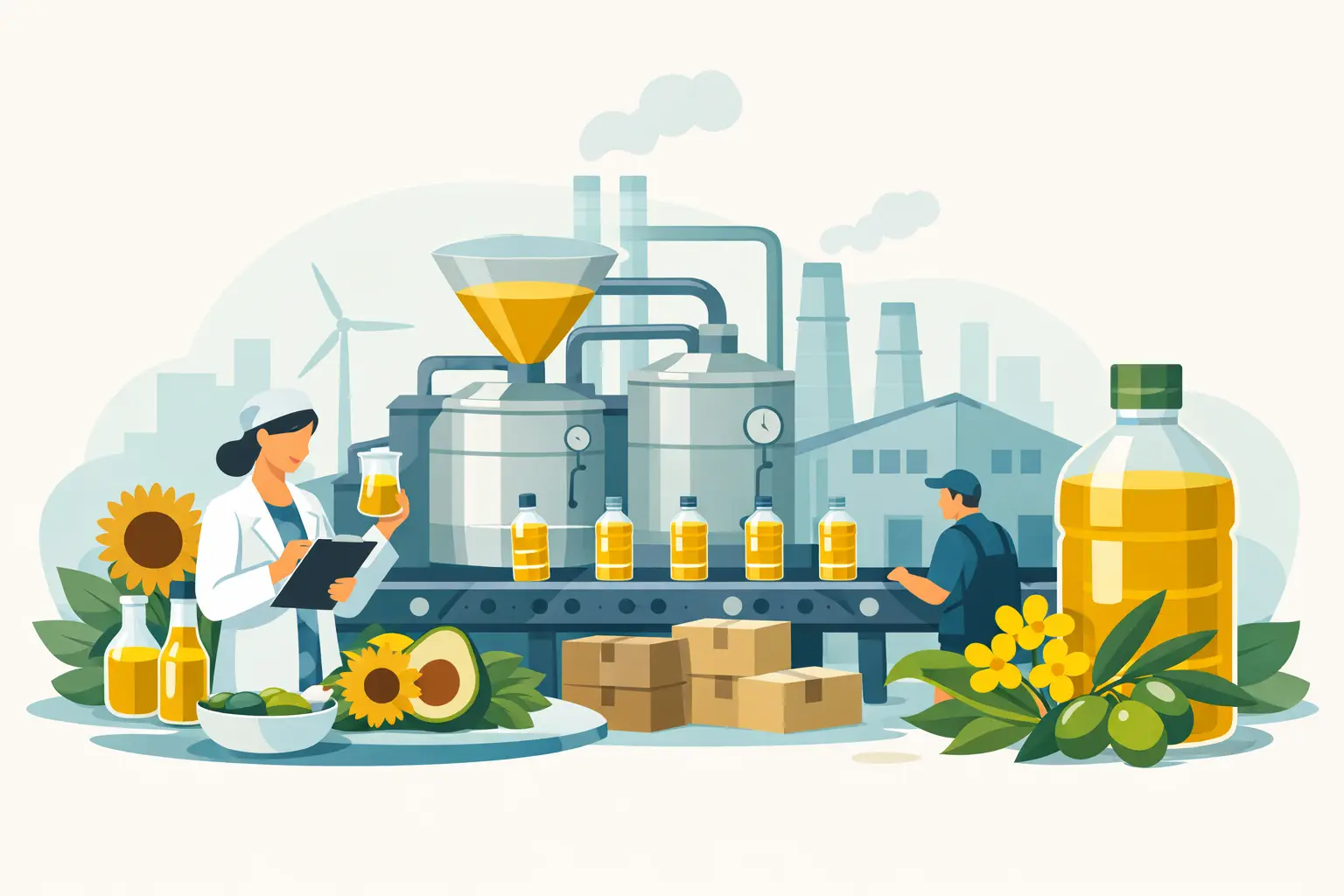
A cooking oil plant fails or succeeds long before the first liter is filled. The real test is whether the business can secure seed supply, run efficient extraction, meet food-grade standards, and sell volume at workable margins. If you are evaluating how to start a cooking oil manufacturing business, the starting point is not branding. It is plant economics, raw material access, and buyer demand.
Cooking oil is a staple commodity. That creates opportunity, but it also creates pressure. Buyers compare suppliers on consistency, pricing, documentation, lead times, and operational reliability. A small mistake in sourcing or processing can erase margin quickly. A strong setup begins with a clear production model.
How to start a cooking oil manufacturing business with the right model
The first decision is what kind of manufacturer you want to be. Some businesses buy crude oil and focus on refining and packing. Others crush oilseeds and produce crude or refined oil in-house. Some operate as bulk suppliers for food manufacturers and distributors, while others build retail packaging lines for supermarket channels.
Each model has different capital needs and different risks. Seed crushing gives more control over supply and product quality, but it requires heavier investment in equipment, storage, and process management. Refining purchased crude oil reduces agricultural exposure, but margins depend heavily on procurement discipline and market timing. Retail packaging can improve value per unit, but it adds marketing, design, and distribution costs that many industrial producers do not want.
For most serious entrants, the practical choice is to define one lane early. If your intended customers are wholesalers, importers, and food processors, a bulk-oriented production model is usually more stable than trying to build a consumer brand from day one.
Start with raw material availability, not equipment catalogs
Cooking oil manufacturing is tied directly to agricultural supply. Your business case must match the crops available in your region or the imports you can secure at scale. Sunflower, soybean, canola, palm, corn, and peanut oil each come with different procurement structures, processing needs, yields, and market expectations.
In sunflower oil, for example, seed quality and oil content have a direct effect on profitability. A low purchase price is not automatically a good deal if moisture, foreign matter, or poor storage conditions reduce extraction efficiency. The same principle applies across oilseeds. Before you invest in machinery, you need realistic numbers for raw material volume, seasonality, transport costs, and storage losses.
This is where many new operators misjudge the business. They focus on machine capacity but ignore whether they can feed the plant steadily. A 100-ton-per-day facility is only useful if seed procurement, warehousing, and working capital support that throughput.
Plant setup depends on the product you plan to sell
A cooking oil manufacturing plant is not a single machine purchase. It is a process line. Depending on the model, that may include seed cleaning, dehulling, cracking, conditioning, pressing, solvent extraction, filtration, refining, deodorization, winterization, storage, and filling.
If you plan to sell crude oil in bulk, the process can be simpler than a fully refined retail-ready operation. If your target market requires refined, bleached, and deodorized oil, the technical standard is higher and so is the capital requirement. Some export markets and industrial buyers also require specific quality parameters, traceability records, and consistent batch documentation.
Utilities matter as much as the process equipment. Power stability, steam generation, water quality, wastewater handling, fire safety systems, and storage tank design all affect cost and reliability. New manufacturers often underestimate how much of the budget will go outside the core production line.
Location also changes the equation. A plant near oilseed supply can reduce inbound logistics. A plant near a port, rail connection, or major industrial corridor can improve outbound economics. There is no universal best answer. The right site depends on whether your margin is more sensitive to raw material transport or finished product distribution.
Compliance is part of the business model
Edible oil production is a food manufacturing activity, not just an industrial process. That means regulatory approvals, food safety procedures, sanitation controls, and documentation must be built into operations from the beginning. If you plan to export, buyer requirements can be stricter than local minimum standards.
At a minimum, your business should be designed around food-grade handling, traceability, batch control, and quality testing. Depending on market and product, that may include testing for free fatty acid levels, peroxide value, moisture, impurities, color, and contaminant risk. Packaging materials, storage tanks, and transport methods must also meet food-contact requirements.
Procurement teams do not only buy oil. They buy supply confidence. A plant that can show consistent process control, product specifications, and organized documentation is more credible than one that simply quotes a low price.
Build your financial model around throughput and margin pressure
Anyone asking how to start a cooking oil manufacturing business needs a realistic financial model before construction begins. This sector is capital-intensive and margin-sensitive. Your model should include equipment, land or lease, utilities, storage, laboratory setup, labor, permits, logistics, maintenance, insurance, and working capital.
Working capital is often the pressure point. Oilseeds and crude oil purchases require cash, and buyers may not pay immediately. If you need to hold inventory through seasonal cycles, financing needs increase further. A plant can be technically sound and still fail because procurement cash flow was weak.
You also need to model different market scenarios. What happens if seed prices rise sharply but finished oil prices lag? What happens if your yield is lower than forecast in the first six months? What happens if you run below target capacity because sales ramp more slowly than expected? These are not side questions. They determine whether the business can absorb normal volatility.
A conservative model is better than an optimistic one. In commodity processing, the downside appears faster than expected.
Sales planning should happen before commissioning
A cooking oil plant should not be built on the assumption that buyers will appear once production starts. Sales channels need to be defined in advance. That may include wholesalers, food manufacturers, distributors, private-label packers, exporters, or institutional buyers.
Each channel has different requirements. Bulk buyers care about consistent specifications, vessel or tanker logistics, and supply continuity. Private-label customers may require packaging support, labeling compliance, and tighter planning windows. Export buyers often focus on documentation, shipment coordination, and long-term production reliability.
This is why many industrial producers stay focused on B2B channels. The demand is clearer, the buying criteria are more measurable, and repeat business is driven by performance. An experienced manufacturer such as EKOBIOTEK operates in that logic - category specialization, production capability, and continuity matter more than lifestyle positioning.
Quality control is not a support function
In oil manufacturing, quality control directly protects margin, customer retention, and claim risk. The laboratory function should not be treated as an afterthought. You need reliable incoming raw material inspection, in-process testing, and final product verification.
Poor-quality raw materials can damage yield and create refining challenges. Process drift can affect odor, color, shelf life, and buyer acceptance. Packaging failures can create contamination or leakage claims. In bulk supply, one rejected shipment can disrupt more than one month of expected revenue.
The practical answer is simple: standardize specifications, train operators, document results, and act on deviations quickly. Consistency is a commercial advantage.
Scale carefully
There is a tendency to overbuild at launch. Larger plants may look more efficient on paper, but underutilized capacity is expensive. It increases fixed-cost pressure and can create procurement strain before the customer base is mature.
A better approach is to size the plant around realistic feedstock access, financing capacity, and contracted demand. Expansion is easier when the first line is stable, documented, and selling. Starting smaller does not always mean thinking small. It often means protecting the business during its highest-risk stage.
The strongest cooking oil manufacturers are not defined by equipment alone. They are defined by disciplined sourcing, process control, and the ability to supply the right product consistently to the right buyers. If you build the business on those foundations, growth has a practical base instead of a hopeful one.