

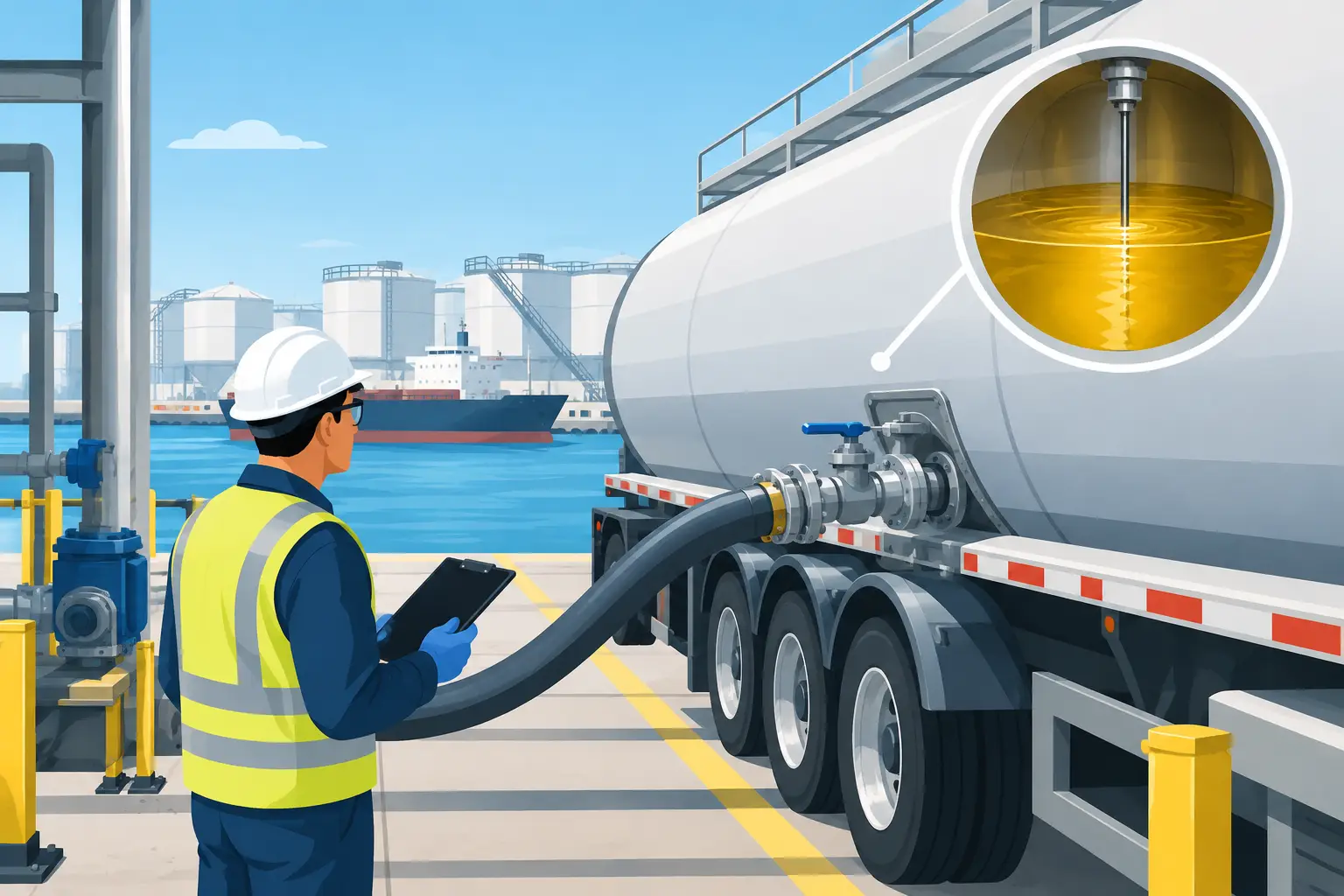
A tanker can arrive on schedule with correct paperwork and still be unsuitable for edible oil. A residue from a previous cargo, a damaged hose connection, an open valve, or a seal mismatch can create a quality claim that is expensive to resolve after delivery. Knowing how to inspect tanker loading is therefore a release-control task, not simply a logistics check. For bulk sunflower oil and other vegetable oils, the inspection must protect food safety, product identity, net quantity, and traceability.
The exact procedure depends on the product specification, destination market, customer contract, and the loading site's approved operating procedures. However, the inspection principles remain consistent: verify the tanker before use, control the transfer while it occurs, and document the condition of the load before the vehicle leaves the facility.
Inspection Begins Before the Tanker Reaches the Loading Bay
A reliable loading inspection starts with advance confirmation. The carrier should provide the vehicle identification, compartment configuration, capacity, driver details, cleaning documentation, and the planned arrival time. This gives the loading team an opportunity to compare the equipment with the dispatch order before product is allocated.
For edible oils, the tanker must be approved for food-grade service. Food-grade status is not established by appearance alone. The supplier or carrier should provide evidence of the previous cargoes and tank cleaning. The level of documentation required may be defined by the buyer, the loading facility, applicable food regulations, or a recognized transport standard.
Review the documents against the loading order
Before positioning the tanker, compare the bill of lading or loading instruction with the sales order. Confirm the product name, grade, quantity, delivery address, consignee, lot identification requirements, and any temperature limits. A loading instruction that says refined sunflower oil should not be treated as interchangeable with another vegetable oil, even if both products use similar transport equipment.
The cleaning certificate should identify the tanker number, cleaning date, cleaning location, compartments cleaned, and prior cargo information where required. If the certificate does not clearly correspond to the vehicle presented for loading, stop the process until the discrepancy is resolved. Do not rely on verbal confirmation from the driver where documentary verification is required.
Check the vehicle condition and loading readiness
Inspect the external condition of the tanker before loading. The vehicle should be structurally sound, clean around access points, and free from visible leaks, strong odors, or contamination risks. Check that the tanker number matches the documents and that the correct compartments are available for the planned quantity.
Access covers, manholes, gaskets, valves, caps, and outlet fittings require close attention. Gaskets must be intact and suitable for edible oil service. Damaged threads, loose caps, or worn seals can permit leakage or contamination during transit. If the tanker is insulated or heated, verify the condition and status of the heating system, but do not apply heat without product-specific instruction. Excessive temperature can affect oil quality and may create avoidable handling concerns.
How to Inspect Tanker Loading at the Loading Point
Once the tanker is accepted, position it according to site traffic and safety rules. Apply wheel chocks or other approved immobilization measures, confirm the vehicle is grounded where required, and establish clear communication between the driver and loading operator. The driver should understand whether they are permitted to operate valves, remain in a designated area, or assist only under direct site instruction.
The product transfer route must be identified before any valve is opened. Confirm the source tank, product line, pump, hose, connection point, and receiving compartment. This is particularly important where multiple oils, grades, or batches are handled at one facility. A correct tanker connected to the wrong line is still a loading failure.
Verify cleanliness of the transfer path
The tanker is only one part of the food-contact system. Hoses, loading arms, pumps, filters, sample points, and pipelines must also be suitable for the oil being loaded. Review the line clearance or line-flush procedure required at the facility. Any retained product from a previous run must be assessed against the current product specification and customer requirements.
Before connecting, inspect the hose or loading arm for visible damage, cleanliness, and secure fittings. Use only dedicated or properly cleaned equipment approved for edible oils. Connections should be made carefully to prevent product loss and to avoid introducing foreign material through open fittings.
If the operation uses a filter, check that the correct filter arrangement is installed and that maintenance or change records are current. The purpose is not merely to meet a checklist. It is to prevent physical contamination from entering a bulk shipment that may later be processed, packaged, or blended by the buyer.
Monitor product condition during transfer
Confirm that the product released from the storage tank corresponds to the assigned batch or lot. Where the quality system requires it, verify release status through the certificate of analysis, laboratory approval, or production release record before loading starts. Relevant parameters for edible oil may include appearance, odor, moisture and volatile matter, free fatty acids, peroxide value, phosphorus, or other contract specifications.
Monitor the loading rate and tanker level throughout transfer. Overfilling can cause spills, product loss, and unsafe conditions. Underfilling may create a commercial dispute if the net quantity does not match the shipping documents. Use calibrated measurement systems where available and record the final quantity according to the facility's approved method.
Temperature should be checked at the point required by the procedure. Some oils require controlled temperature to maintain pumpability, especially during colder periods. The target is not simply to load warm product. It is to keep the oil within the agreed handling range without unnecessary thermal exposure.
Control the Final Release of the Loaded Tanker
After transfer, allow the system to drain according to the loading procedure and close all relevant valves. Inspect hose disconnection points for leaks and ensure caps or covers are correctly fitted. The tanker compartments should be closed before seals are applied.
Sealing is a practical control for both product protection and chain of custody. Record each seal number on the transport documentation and, when applicable, in the loading system. The driver should confirm the seal numbers before departure. If a seal breaks during transit for an authorized inspection, that event should be documented with a replacement seal number and reason.
Take a representative sample if required by the contract or quality system. The sample container must be clean, correctly labeled, and protected from mix-up. Record the product, batch or lot number, tanker number, date, sampling point, and sampler identification. Retained samples are especially useful when a customer later reports an off-odor, unexpected analytical result, or suspected transport contamination.
The final document review should confirm the loaded quantity, product designation, lot information, seal numbers, destination, and any special temperature or handling instructions. A discrepancy discovered at the gate is easier to correct than one found after the tanker has crossed a border or reached a customer's plant.
When a Tanker Should Be Rejected or Held
The loading team should have clear authority to stop or hold a tanker when acceptance criteria are not met. Pressure to meet a dispatch schedule is not a reason to bypass food safety or contractual controls. A short delay at origin is usually less costly than a rejected shipment at destination.
Common reasons for rejection or hold include incomplete cleaning records, an unacceptable previous cargo, visible residue or odor, damaged gaskets or valves, incorrect tanker identification, unapproved equipment, missing seals, or a mismatch between the loading order and the product prepared for dispatch. The issue should be recorded, communicated to transport coordination and quality personnel, and resolved before loading resumes.
Not every issue requires permanent rejection. A missing document may be corrected, a faulty gasket may be replaced, or a tanker may be re-cleaned and reinspected. The decision should be based on documented acceptance criteria rather than assumption.
Build Traceability Into the Inspection Record
A strong tanker loading record connects the finished oil to the transport unit and the customer shipment. At minimum, it should show the date and time, tanker identification, carrier, driver, product, batch or lot, quantity, inspection outcome, seal numbers, and names or signatures of responsible personnel. Digital records can improve retrieval, but the control is only as good as the accuracy of the information entered.
For an established edible oil producer, consistent records demonstrate that bulk supply is managed as a controlled manufacturing process through the point of dispatch. They also give procurement teams and receiving facilities a factual basis for investigating any issue without relying on memory or incomplete carrier information.
A tanker should leave the site only when the product, equipment, documents, and seals all tell the same story. That discipline protects the buyer's operation and preserves the value of the oil that was produced for shipment.