
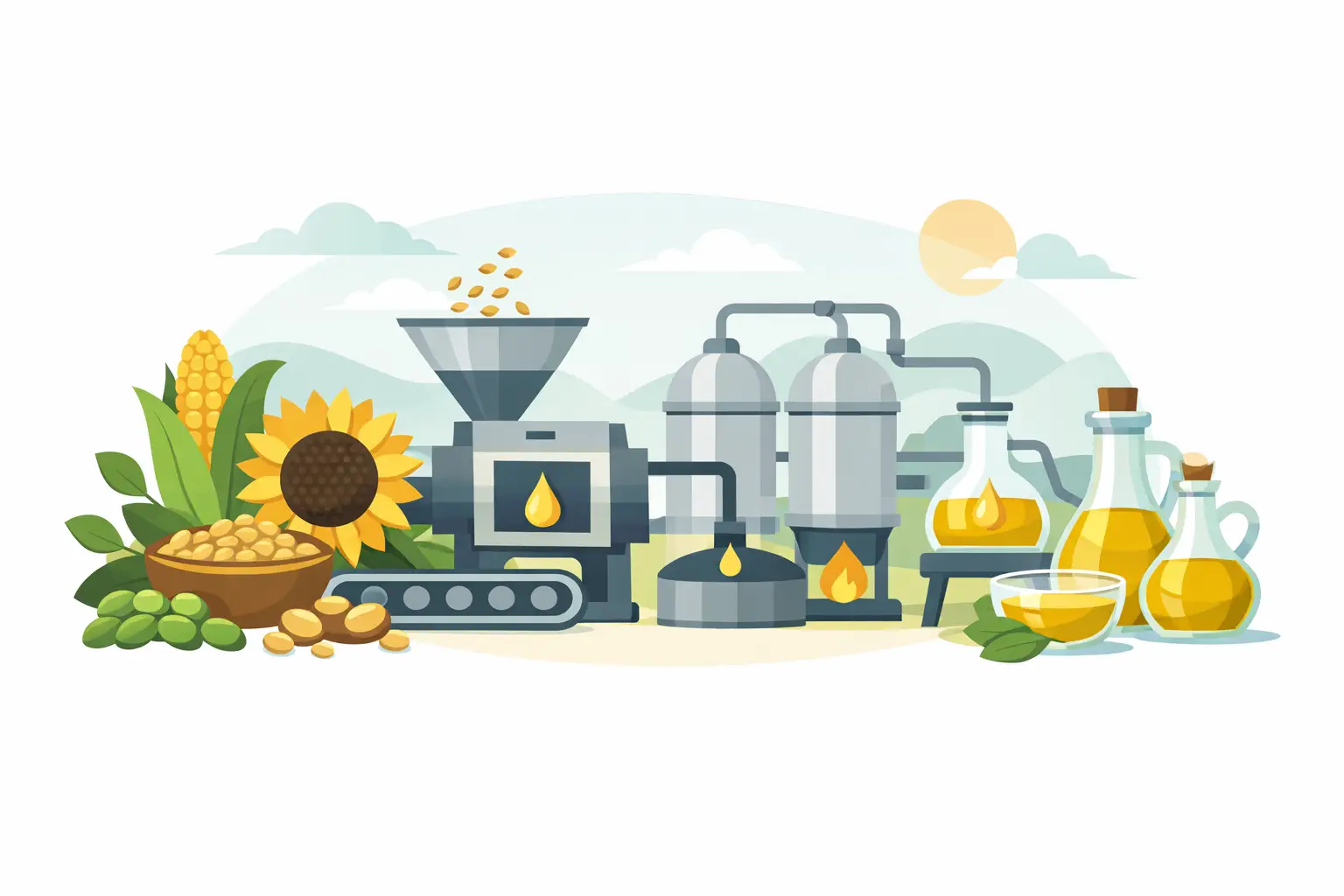
Vegetable oil is a simple product on paper, but for a commercial buyer, the process behind it determines far more than appearance. When buyers ask how are vegetable oils made, they are usually evaluating yield, consistency, refining standards, shelf stability, and whether a producer can meet repeat volume requirements without variation.
The answer depends on the oilseed, the target specification, and the intended market. Sunflower, soybean, rapeseed, corn, and other plant sources follow the same industrial logic, but not every oil goes through exactly the same treatment. Some buyers need crude oil for further processing. Others need fully refined, food-grade oil ready for bottling, formulation, or distribution.
How are vegetable oils made in industrial production?
At industrial scale, vegetable oils are produced by separating oil from plant material, then treating that oil to meet commercial and food safety requirements. The process typically begins with seed reception and preparation, continues through mechanical pressing and, in many cases, solvent extraction, and ends with refining.
This sounds linear, but production decisions are made at each stage. A processor balances oil recovery, product quality, operating cost, and final specification. Higher extraction efficiency can improve yield, but it also adds process complexity. More intensive refining can improve clarity and neutrality, but it may remove some natural components that certain markets value.
For B2B buyers, this matters because the manufacturing route affects not only price, but also performance in frying, food processing, blending, and storage.
Raw material selection sets the baseline
The first determinant of oil quality is the raw material itself. Seeds or fruits must arrive with acceptable moisture, impurity levels, and physical condition. In sunflower processing, for example, damaged seeds, excess foreign matter, or unstable storage conditions can reduce yield and increase refining losses.
Before extraction begins, the incoming material is inspected and cleaned. This stage removes dust, stones, metals, husks, and other foreign particles. Clean raw material protects equipment and helps stabilize downstream quality. For industrial buyers, consistent raw material handling is one of the clearest indicators of a disciplined producer.
Some oilseeds are also dehulled before further processing. Removing hulls can improve extraction efficiency and reduce the amount of non-oil material entering the system. Whether dehulling is used depends on the seed type and the intended product profile.
Seed preparation before oil extraction
After cleaning, the seeds are conditioned for extraction. This stage often includes cracking, flaking, and heating. Cracking breaks the seed into smaller pieces. Flaking increases surface area, which helps release oil during pressing or solvent extraction. Heating softens the internal structure and improves oil flow.
Preparation is not a minor step. If moisture or temperature is not controlled well, extraction efficiency can fall and product quality can become less predictable. Well-managed preparation supports both throughput and uniformity, which are critical in large-volume supply.
In sunflower oil production, proper preparation also helps preserve the characteristics expected from the seed while allowing efficient recovery. An experienced processor treats preparation as part of quality control, not just a mechanical step.
Pressing and extraction
Most commercial vegetable oils are obtained through one of two methods, or a combination of both: mechanical pressing and solvent extraction.
Mechanical pressing uses expellers or screw presses to force oil out of prepared seed material. This method is common and can produce crude oil with a relatively straightforward process route. Pressing is often the first stage in large industrial systems because it removes a significant portion of the oil efficiently.
However, pressing alone usually does not recover all available oil. Residual oil remains in the press cake. For that reason, many large-scale operations send the cake to solvent extraction, where a food-grade solvent, commonly hexane, is used to separate more of the remaining oil. The solvent is later removed and recovered within the process system.
This combined method is widely used because it improves total yield. For bulk buyers, better yield can support more competitive pricing and more stable production economics. At the same time, the process must be tightly controlled. Solvent handling, desolventizing, and recovery systems require proper engineering and operational discipline.
Not every oil is produced the same way. Some specialty oils are pressed only, especially where a less processed market position is desired. But in mainstream commercial edible oil production, especially at volume, extraction efficiency is a major commercial factor.
Crude oil handling
The oil that comes directly from pressing or extraction is crude oil. It contains not only triglycerides, but also phospholipids, free fatty acids, pigments, waxes, trace metals, and other natural compounds from the seed.
Crude oil can be sold in some industrial channels if the buyer intends to refine it independently. More often, it moves to further processing at the production site. Before refining, the crude oil may go through settling or filtration to remove suspended solids. This improves process control in later stages.
At this point, the oil is not yet aligned with most finished food-grade expectations for color, odor, taste neutrality, or shelf stability. Refining is what turns crude vegetable oil into a more standardized commercial product.
How are vegetable oils made ready for food use?
Refining usually involves several core stages: degumming, neutralization, bleaching, and deodorization. Depending on the oil type, winterization or dewaxing may also be required.
Degumming removes phospholipids and related compounds. This step is important because gums can affect stability and create issues in later processing. Neutralization reduces free fatty acids, often through alkali treatment, which improves taste and storage performance.
Bleaching does not mean adding bleach. It refers to the use of adsorbent materials to remove pigments, oxidation products, and trace contaminants. The result is a cleaner and more commercially acceptable oil appearance. Deodorization then uses steam under vacuum at elevated temperature to remove volatile compounds responsible for odor and flavor.
For oils such as sunflower oil, dewaxing can also be necessary. Sunflower oil naturally contains waxes that may cause cloudiness at lower temperatures. Removing them supports clarity in finished product applications.
Each refining stage improves usability, but refining intensity must match the market. A buyer for snack manufacturing, bottled retail oil, or foodservice frying oil may require different parameters. This is why serious suppliers work to a defined specification, not a generic process description.
Quality control is part of production, not an afterthought
In edible oil manufacturing, quality control runs through the entire process. It starts with raw material inspection and continues through extraction, refining, storage, and loading. Standard checks often include moisture, impurity level, color, free fatty acid content, peroxide value, phosphorus, and other specification points depending on the product.
Consistency matters as much as compliance. A single acceptable batch is not enough for commercial buyers managing regular imports or industrial formulations. They need repeatable product behavior across shipments.
Storage conditions also affect final quality. Oil must be held in suitable tanks under controlled conditions to reduce oxidation and contamination risk. Handling systems, tank hygiene, and loading procedures all influence whether the product that arrives matches the product that was specified.
For an experienced producer, manufacturing is not only about extracting oil from seed. It is about maintaining control from intake to dispatch.
The main trade-offs in vegetable oil production
There is no single best process for every market. Press-only production can support certain positioning and process simplicity, but total oil recovery is lower. Combined pressing and solvent extraction usually improves yield, though it requires more complex infrastructure.
Refining can create a more neutral and stable product suited to broad food applications, but some buyers may prefer less-refined oil for specific industrial or regional uses. Higher refinement can improve appearance and shelf performance, while lower processing may preserve more of the oil's native character.
The right approach depends on the buyer's application, destination market, and commercial priorities. Procurement teams should not evaluate vegetable oil only by headline price. Process route, refining capability, and quality discipline all affect delivered value.
What buyers should understand when sourcing
When evaluating a supplier, the useful question is not only how are vegetable oils made, but how that specific producer makes them, controls them, and supplies them at scale. Two suppliers may offer the same oil type while operating with different extraction methods, refining standards, and quality assurance practices.
For that reason, buyers typically review origin, production history, category specialization, and consistency of supply alongside specification sheets. A manufacturer with established process capability is generally better positioned to support long-term contracts than a trader without production control.
Ukraine remains closely associated with sunflower cultivation and oil production, which gives buyers a practical reference point when assessing sourcing depth in this category. Producers focused on vegetable oils as a core manufacturing activity, including companies such as EKOBIOTEK, are assessed on that basis: process control, continuity, and the ability to deliver commercially reliable product.
Vegetable oil manufacturing is not complicated in theory. In practice, the difference between average supply and dependable supply is made in the details of preparation, extraction, refining, and control. That is the part buyers should keep in view when comparing offers.