

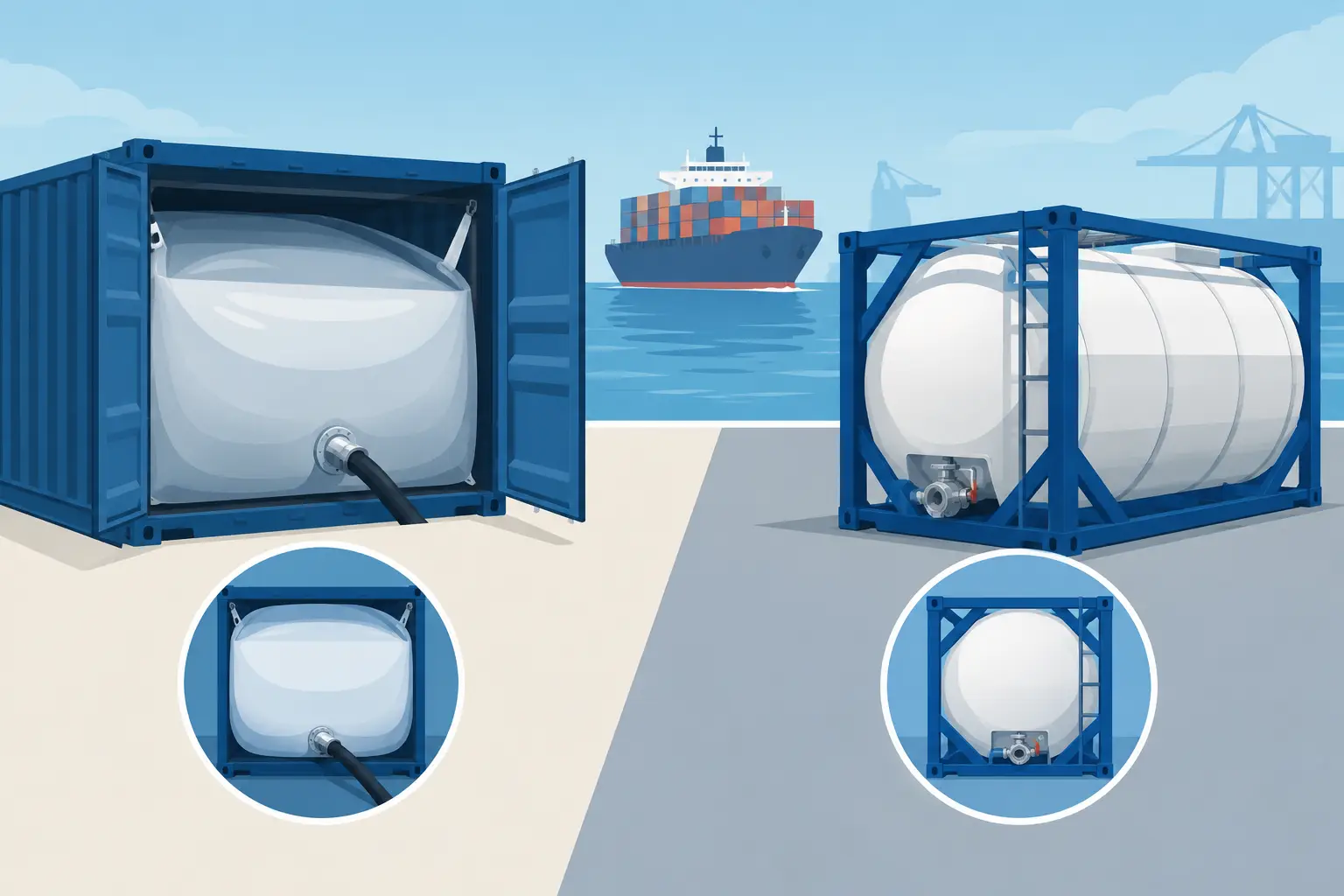
A container decision can affect delivered oil cost, discharge timing, quality controls, and the number of operational parties involved in a shipment. For importers of sunflower oil and other edible oils, flexitank versus isotank oil shipping is not a simple question of selecting the lowest freight quotation. The correct option depends on shipment frequency, destination infrastructure, product specifications, and the controls required from loading through final unloading.
Flexitank versus isotank oil shipping: the basic difference
A flexitank is a single-use, food-grade polymer liner installed inside a standard 20-foot dry freight container. The liner is filled with bulk liquid through a valve, secured for transport, and normally discharged by pump at destination. Depending on the liner design, container condition, cargo density, and transport requirements, a flexitank commonly carries approximately 16,000 to 24,000 liters.
An ISO tank, often called an isotank, is a reusable stainless-steel tank mounted in an ISO container frame. It is purpose-built for bulk liquid transport and generally has a capacity in the range of 21,000 to 26,000 liters, subject to its specification and permitted gross weight. The tank is cleaned, inspected, and prepared between loads by an approved depot or service provider.
Both systems can move edible oils internationally. Neither is automatically better for every oil program. A buyer should assess the transport equipment as part of the complete supply chain, rather than treating it as a separate logistics detail.
Where flexitanks fit best
Flexitanks are commonly selected for one-way export movements where a standard dry container can reach the loading point and the receiver has suitable unloading equipment. Their principal commercial advantage is that they can use broadly available dry-container capacity. In lanes where ISO tank availability is limited, this can simplify shipment planning.
For a producer shipping a full container of refined or crude vegetable oil to a buyer that will receive and discharge the cargo promptly, a flexitank may offer a competitive total cost. There is no empty tank to reposition back to its owner after delivery. The liner is removed after discharge, which eliminates return cleaning and return freight responsibilities associated with a reusable tank.
The trade-off is that flexitank performance depends heavily on correct installation and container suitability. The dry container must be structurally sound, clean, odor-free, and appropriate for the liner system. Installation should be performed by trained personnel following the liner supplier's instructions. A damaged floor, sharp internal surface, unsuitable container, or incorrect bracing can create avoidable risk.
Flexitanks are also best suited to cargoes that can be loaded and discharged without extensive temperature management. Many edible oils remain pumpable under normal conditions, but some grades can thicken or partially solidify in cold weather. If a route includes winter exposure, long inland transit, or a cold destination, the receiving plan must address temperature before the container leaves origin.
Where ISO tanks fit best
ISO tanks are often the stronger choice for regular, repeatable oil flows, especially when the cargo needs controlled heating, specialized handling, or disciplined equipment management. Stainless-steel construction provides a durable transport vessel, while many tank configurations can support insulation, steam heating, or electric heating arrangements. Availability of these features varies by tank operator and equipment type, so they must be confirmed before booking.
For oil that may require warming before discharge, an ISO tank can reduce operational uncertainty. It may allow the cargo to be brought to an appropriate pumping temperature under controlled conditions, provided the terminal or receiver has the necessary connections and follows the specified heating procedure. Excessive heating can affect oil quality, so the agreed temperature range and maximum exposure period should be part of the shipping instructions.
An ISO tank also suits customers that receive bulk liquids through established tank-terminal, rail, or specialized trucking networks. These facilities are designed around tank handling, cleaning documentation, inspections, and scheduled discharge. For recurring supply programs, the reusable equipment model can create better consistency than arranging a new liner and dry container for every shipment.
The commercial limitation is that isotanks require equipment positioning and return management. Tank availability at origin, demurrage or detention exposure, cleaning charges, and empty repositioning can materially affect the final cost. A low ocean freight rate does not necessarily mean the tank option is less expensive after these items are included.
Food safety and quality controls matter more than the vessel name
For edible oil buyers, the transport system must support the product specification and food-safety requirements. A flexitank should be certified or documented as suitable for food contact, and its loading procedure should protect the oil from contamination. The container interior, liner material, hoses, fittings, pumps, and sampling equipment all matter.
With an ISO tank, the critical question is the cleaning standard and prior cargo history. The buyer should require a valid cleaning certificate and confirm that the tank is acceptable for edible-oil service. Previous cargo restrictions, valve condition, gasket compatibility, and tank inspection status should be reviewed before loading. A stainless-steel tank is not inherently ready for food cargo without proper cleaning and verification.
For either method, loading records should identify the product, batch or lot, net weight, seal numbers, loading date, and agreed temperature where applicable. Retained samples, if required under the supply contract, should be drawn and labeled under controlled conditions. These steps support traceability if a quality claim arises after arrival.
Sunflower oil is sensitive to poor handling even when its basic transport requirements appear straightforward. Moisture ingress, foreign odor, residue, excessive heat, and long delays before discharge can all create commercial issues. Transport instructions should therefore be aligned with the oil grade, packaging format, destination climate, and buyer's storage process.
Comparing delivered cost, not only freight
Flexitanks often have a lower entry cost because they use standard containers and disposable liners. This can be attractive for occasional shipments or new trade lanes. However, the quotation should include the liner, installation, container inspection, loading labor, discharge requirements, disposal, and any special insurance conditions.
ISO tank pricing should include tank hire, positioning, cleaning, heating if required, terminal handling, return transport, and potential detention or demurrage. On a stable route with frequent volume, these costs may be predictable and commercially justified. On an irregular route, they may be harder to control.
Capacity should be evaluated in metric tons, not liters alone. Vegetable oil density varies by product and temperature, and allowable payload is limited by road, rail, and container weight rules. A shipment that appears to offer more liquid volume may not deliver more saleable product once weight restrictions and loading limits are applied.
Operational questions to settle before booking
The shipment plan should identify who is responsible for equipment approval, loading supervision, seals, export documents, temperature instructions, and discharge scheduling. It should also define the receiving party's pumping capability and the time allowed to unload the cargo. These points are especially relevant for flexitanks, where a delayed discharge can leave a loaded dry container occupying space and accumulating charges.
For ISO tanks, the contract should state the accepted cleaning documentation, prior-cargo restrictions, heating requirements, and return conditions. If the oil will be discharged at a third-party terminal, confirm in advance that the terminal accepts the tank configuration and can connect to its valves and heating system.
Route conditions deserve the same attention. A short port-to-port movement to a warm market may favor a flexitank. A long multimodal route, winter transit, or delivery into a facility built around bulk tank handling may favor an ISO tank. Carrier acceptance policies, local regulations, and port practices can also determine what is practical on a given lane.
Selecting the right option for an edible oil program
Flexitanks are generally most suitable when the shipment is one-way, the oil remains readily pumpable, standard containers are available, and the receiver can discharge efficiently. ISO tanks are generally more suitable when the trade is recurring, temperature control is needed, tank-terminal handling is available, or the buyer requires a reusable vessel with established cleaning and inspection controls.
The decision should be made before the sales contract is finalized, not after production is ready for dispatch. A supplier and buyer that agree early on transport mode, cargo temperature, documents, discharge capability, and cost allocation can avoid the most common disputes. For bulk sunflower oil programs, the useful question is not which vessel is better in general, but which one protects the product and keeps the delivered supply plan predictable on that specific route.