
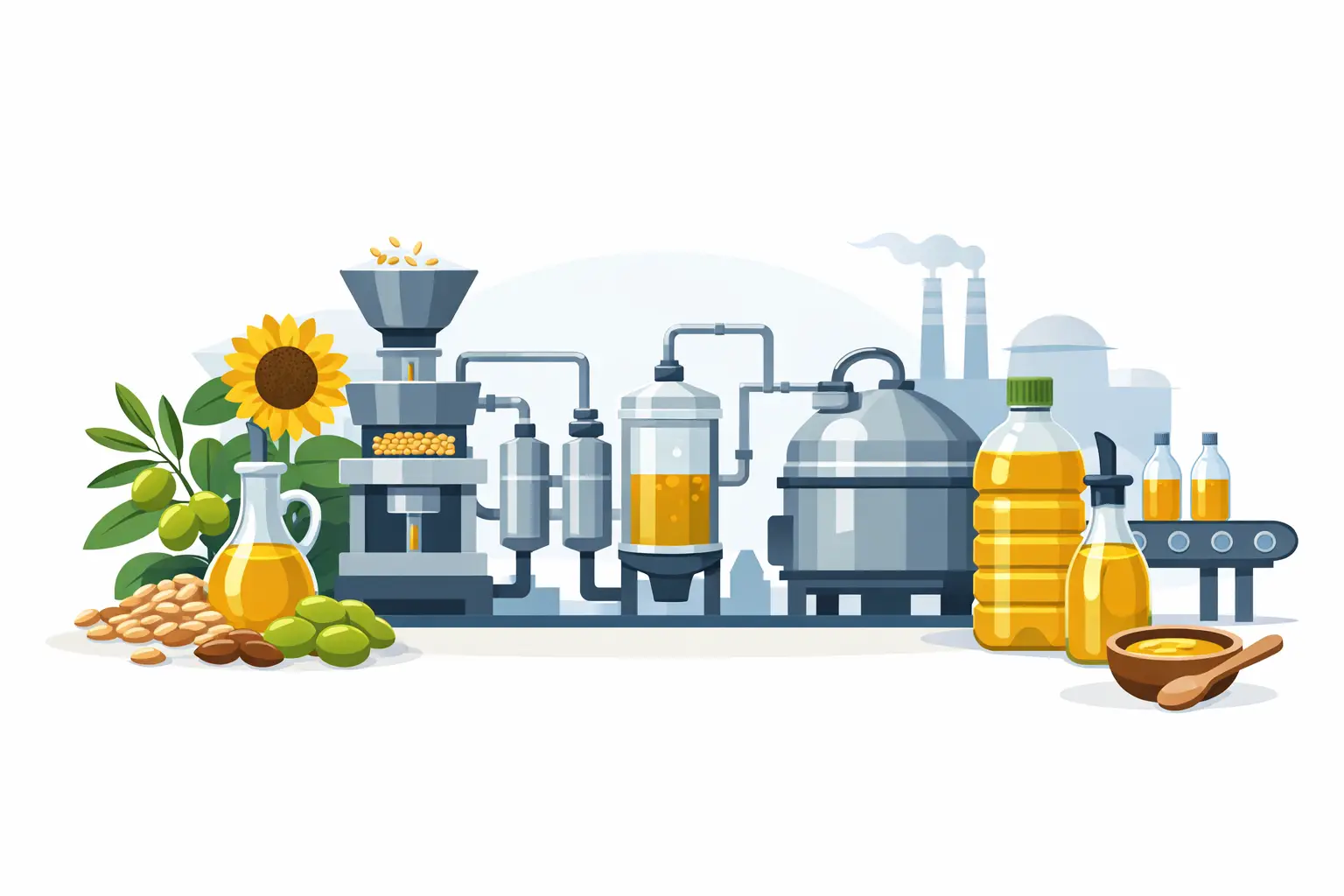
For bulk buyers, the edible oil manufacturing process is not a background detail. It directly affects oil yield, product consistency, shelf stability, traceability, and the supplier’s ability to meet contract volumes. When sourcing sunflower oil or other vegetable oils, understanding how production is structured helps separate actual manufacturers from traders and helps buyers assess operational reliability.
In practice, edible oil production is a controlled industrial sequence. Raw material condition, extraction method, refining parameters, filtration, storage, and loading standards all influence the final product. Small differences at any stage can affect free fatty acid levels, color, odor, clarity, and long-term storage behavior.
What the edible oil manufacturing process includes
At industrial scale, the edible oil manufacturing process starts long before oil is visible in a tank. It begins with raw material acceptance and continues through preparation, extraction, refining, quality control, storage, and dispatch. For sunflower oil, this usually means managing oilseed quality from intake through finished bulk shipment.
The exact configuration depends on the oil type, target specification, and plant setup. Sunflower oil, soybean oil, corn oil, and rapeseed oil follow similar production logic, but process details vary based on seed structure, oil content, and the intended end use. A buyer sourcing crude oil for further processing will evaluate different parameters than a buyer sourcing fully refined oil for food manufacturing.
Raw material intake and seed preparation
The first production checkpoint is raw material acceptance. Seeds are evaluated for moisture, foreign matter, damage, and general condition. This matters because poor incoming material reduces extraction efficiency and creates instability later in the line. High moisture can increase spoilage risk. Excess impurities can affect equipment performance and oil quality.
After acceptance, seeds move through cleaning. Dust, stems, metal particles, husk fragments, and other foreign materials are removed using screens, magnets, aspiration systems, and separators. Clean seed is not just a quality issue. It protects downstream equipment and supports stable throughput.
Conditioning follows. Depending on the process design, seeds may be dried, heated, dehulled, cracked, or flaked. The purpose is to prepare the material for efficient oil release. For sunflower seed processing, hull content and kernel quality can influence both yield and the character of the resulting oil. There is no single best setup in all cases. A plant may adjust preparation based on crop condition, season, or final product requirements.
Mechanical extraction and solvent extraction
Once prepared, the seed enters the extraction stage. In many edible oil plants, the first step is mechanical pressing. Screw presses apply pressure to release part of the oil from the seed mass. This stage produces crude oil and press cake.
Mechanical extraction is straightforward and widely used, but it does not always recover the maximum possible oil. That is the trade-off. Pressing alone can be suitable for some production targets, especially when process simplicity is preferred, but higher recovery rates often require a second stage.
For larger industrial operations, solvent extraction may be used after pressing or as part of the broader extraction system. In this method, the remaining oil in the cake is separated using an approved solvent system under controlled conditions. This increases total oil recovery and improves material utilization. It also adds complexity, requiring strict process control, solvent recovery, and safety systems.
From a buyer’s perspective, the key point is not whether one method sounds more attractive than the other. The practical question is whether the producer can consistently meet the required specification and volume. A manufacturer supplying bulk contracts needs extraction efficiency, process discipline, and stable output.
Crude oil handling and clarification
Freshly extracted oil is still crude. It contains suspended solids, phospholipids, waxes, trace metals, pigments, and other natural components that must be reduced or removed depending on the target grade. Before refining, crude oil is commonly settled, screened, or filtered to remove larger insoluble particles.
This stage affects both refining performance and finished oil quality. Poor clarification upstream can create inefficiency later, increase refining losses, and produce less stable finished product. Industrial plants therefore treat crude oil handling as part of quality management, not as a minor transfer step.
Crude oil may be marketed as crude if the buyer intends to refine it independently. In that case, the parameters of interest shift. Buyers will focus on consistency of crude oil characteristics, contaminants, and suitability for further processing at their own facility.
Refining in the edible oil manufacturing process
Refining converts crude oil into an edible product suitable for food industry use. The refining sequence can vary, but it generally includes degumming, neutralization or physical refining steps, bleaching, winterization when required, and deodorization.
Degumming removes phospholipids and related impurities. This is important for stability and for the efficiency of later refining stages. Neutralization, where used, reduces free fatty acids. In some systems, physical refining is preferred instead of chemical neutralization, especially where process economics and oil characteristics support it.
Bleaching removes color bodies and trace contaminants through adsorption media under controlled temperature and vacuum conditions. This step is less about making oil look better for retail and more about meeting commercial quality and stability requirements. Over-processing here can reduce efficiency, while under-processing can leave unwanted compounds behind.
Deodorization is the final major refining stage for many edible oils. Under high temperature and vacuum, volatile compounds responsible for odor and flavor are removed. The objective is a neutral, stable oil suited for broad food applications. Process control is essential. Excessive heat can damage quality, but insufficient deodorization can leave the oil outside expected specification.
For some oils and markets, winterization is also required. This removes waxes that can cause cloudiness at lower temperatures. Whether this step is necessary depends on product type and customer use.
Quality control from line to loading
A serious producer does not treat testing as a final paperwork step. Quality control runs through the entire manufacturing cycle. Raw seeds are checked at intake. Process conditions are monitored during extraction and refining. Finished oil is tested before storage and shipment.
Typical control points include moisture, impurity levels, acid value, peroxide value, color, odor, transparency, and other specification-based measures. The exact test program depends on the oil and the destination market. Buyers may also require additional documentation aligned with contract terms or importing requirements.
Consistency matters more than isolated test results. Procurement teams usually need confidence that one shipment will match the next. That level of confidence comes from repeatable process control, not from a single compliant batch.
Storage, tank management, and shipment readiness
Even after refining, oil quality can deteriorate if storage and handling are poorly managed. Tanks, transfer lines, filtration points, and loading systems must be maintained to prevent contamination and preserve product condition. Temperature management also matters, particularly for bulk volumes moving through changing seasonal conditions.
At this stage, industrial discipline is visible. Clean storage infrastructure, proper batch segregation, and accurate loading controls reduce the risk of off-spec deliveries. For international buyers, this is especially relevant because quality must remain stable not just at dispatch, but through transit and receipt.
Bulk supply performance depends on more than plant capacity. It also depends on whether storage and logistics are organized to support continuous movement. A manufacturer with production experience understands that shipping readiness is part of manufacturing reliability.
Why process visibility matters for B2B buyers
For procurement professionals, reviewing the edible oil manufacturing process is part of supplier due diligence. It indicates whether a company is positioned as an actual producer with control over raw material processing, extraction, refining, and shipment quality, or whether it is primarily operating as an intermediary.
This distinction matters when volumes increase, specifications tighten, or market conditions become unstable. A dedicated manufacturer generally has better control over production planning, batch consistency, and problem resolution. That does not eliminate risk, because crop conditions, energy costs, and freight variables still affect supply. But it improves visibility and accountability.
For buyers sourcing sunflower oil from Ukraine, production origin also carries weight. Ukraine remains strongly associated with sunflower cultivation and vegetable oil production. In that context, an experienced producer such as EKOBIOTEK signals category specialization tied to an established manufacturing base rather than opportunistic trading activity.
A practical sourcing review should therefore ask straightforward questions. How is raw material managed? What extraction and refining stages are in place? How is quality controlled across batches? How is finished oil stored and loaded for export? Clear answers to those questions usually tell more about supplier capability than marketing language ever will.
The best purchasing decisions are often made before price discussion is finished. When the production process is clear, controlled, and matched to the buyer’s specification, commercial terms become easier to evaluate with confidence.