

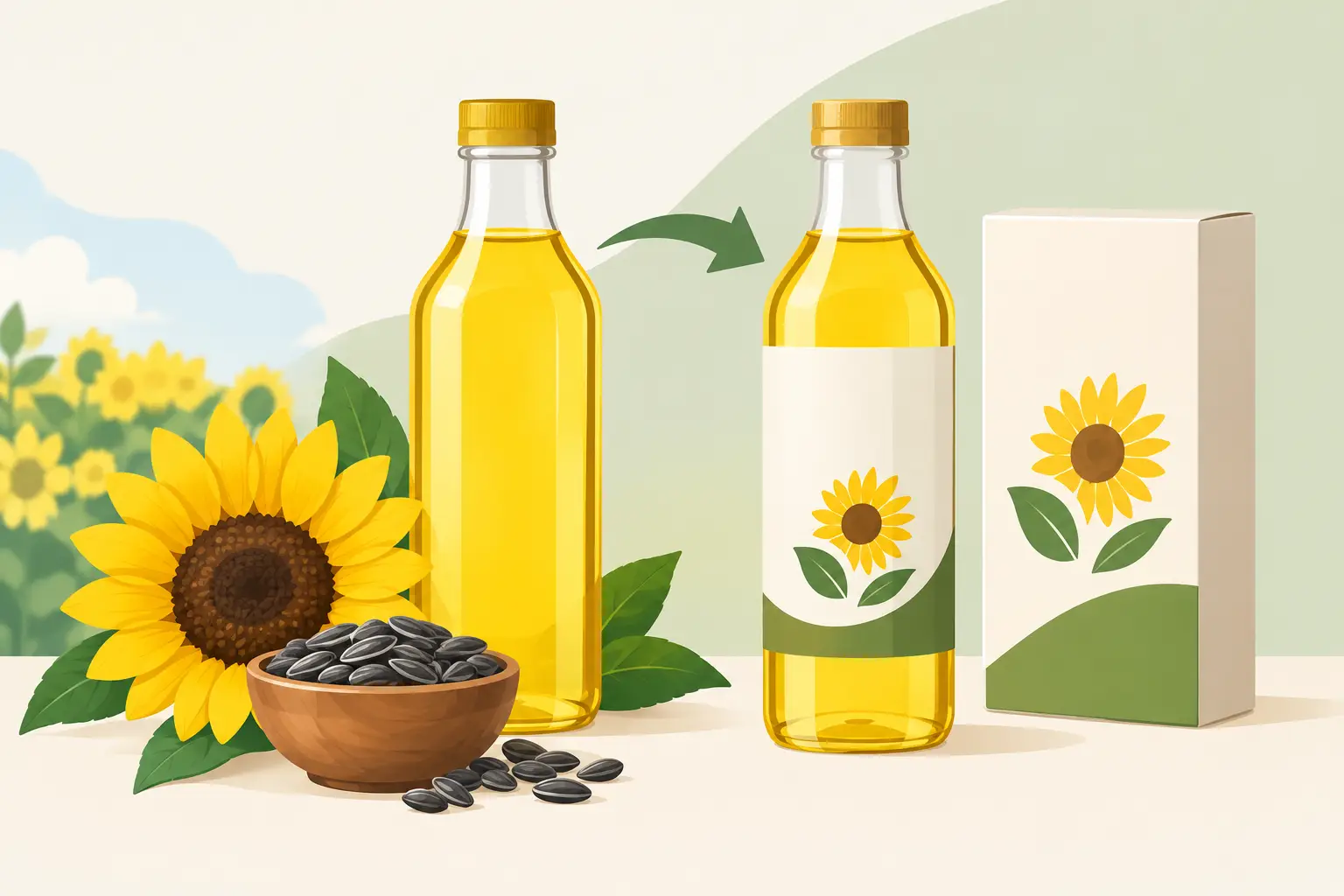
A private-label oil program begins well before a label is applied to a bottle. Buyers must confirm the product specification, packaging format, artwork responsibilities, order volume, and delivery terms. So, can sunflower oil be private labeled? Yes. Sunflower oil can be supplied under a buyer's own brand when the producer and buyer agree on a practical manufacturing and packaging program.
For importers, distributors, retailers, and food-service suppliers, private labeling turns a staple commodity into a controlled commercial product. The opportunity is straightforward, but execution depends on clear specifications and realistic production planning.
Can Sunflower Oil Be Private Labeled for U.S. Buyers?
Yes. Private-label sunflower oil may be packed in retail bottles, food-service containers, or other agreed formats bearing the buyer's brand. The producer supplies the oil and, where included in the arrangement, manages filling, packaging procurement, labeling, palletizing, and export preparation. The buyer controls the market-facing brand, package design, and sales channel.
The exact scope differs by supplier. Some programs involve filling oil into standard bottles with customer-provided labels. Others require a complete packaging solution, including bottle selection, caps, cartons, printed labels, and pallet configuration. A buyer should establish these responsibilities at the quotation stage rather than treating them as details to resolve after the order is confirmed.
Private labeling is generally most effective for buyers with an established distribution route or a defined customer base. A new brand may need smaller initial volumes and more packaging flexibility. A large distributor may prioritize repeatable specifications, production scheduling, and container-level economics. Neither approach is inherently better, but each requires a different commercial structure.
Start With the Oil Specification
The term sunflower oil covers more than one commercial specification. Before discussing packaging, the buyer should define the oil required for the intended use. Refined, deodorized sunflower oil is commonly used for retail cooking oil and food manufacturing because it has a neutral flavor, light color, and broad application range. Other specifications may be relevant depending on the buyer's market and product positioning.
The purchase specification should state the required product type, quality parameters, intended application, and any documentation needed for the destination market. If the oil will be sold as a consumer product, label claims and ingredient declarations must match the actual product. If it will be supplied to food manufacturers, operational consistency may matter more than consumer-facing presentation.
Buyers should also discuss shelf-life expectations, storage conditions, and handling requirements. Vegetable oils are sensitive to poor storage practices. Exposure to excessive heat, air, or light can affect product quality over time. Packaging choice, warehouse conditions, and transport planning should support the agreed shelf-life period.
A serious supplier should be able to work from a written specification rather than a broad product description. This reduces disputes and gives both parties a clear basis for quality control before shipment.
Packaging Determines Much of the Program Cost
Oil price is only one part of a private-label quotation. The final cost also includes the packaging system. Bottle material and size, cap type, label format, carton strength, printing method, pallets, and freight all affect the delivered cost.
Common retail formats include small household bottles, larger family-size bottles, and food-service packs. The right format depends on the buyer's channel. Supermarkets may require shelf-ready cartons and barcodes. Wholesale customers may prefer larger packs that reduce packaging cost per liter. Food-service distributors may need durable containers designed for commercial kitchens.
Printed packaging can create higher setup costs and longer lead times, particularly when custom bottles, shrink sleeves, or printed cartons are required. Standard packaging with pressure-sensitive labels may be more practical for a first order or limited market test. Over time, higher-volume programs can justify more customized components if the commercial benefit is clear.
The label itself must be treated as a compliance item, not only a design asset. U.S. consumer packages may require specific information, including product identity, net contents, ingredient information, nutrition labeling where applicable, responsible business details, and other required declarations. Importers should verify requirements for the exact product and market before final artwork approval. The producer can provide product information, but the brand owner and importer should not assume that a standard label will meet every market requirement.
Minimum Order Quantity Is a Production Question
Private-label buyers often ask for a minimum order quantity first. The more useful question is what volume makes the selected packaging program commercially workable. Minimums are affected by production runs, packaging supplier requirements, artwork setup, filling efficiency, and shipping configuration.
A standard bottle and label arrangement may allow greater flexibility than a fully custom package. In contrast, custom molded bottles, printed film, or specialized caps may require larger volumes because packaging vendors have their own minimum production quantities. A buyer seeking a low initial commitment should be prepared to use existing formats where possible.
Order quantity also affects freight efficiency. For international shipments, full-container volumes often provide better cost control than fragmented cargo. This does not mean every buyer must begin with the largest possible order. It means the supplier and buyer should compare product volume, packaging volume, and transport cost together.
Forecasting matters after the first shipment. Sunflower oil is a recurring staple purchase, and a supplier can plan more effectively when it understands expected reorder timing. Buyers that provide realistic forecasts are better positioned to secure packaging materials, reserve production capacity, and reduce avoidable delays.
Quality Control Must Be Defined Before Filling
Private labeling does not change the need for consistent product quality. The buyer should agree on the inspection and documentation process before production begins. This may include batch records, product specifications, certificates of analysis, packing lists, and export documents appropriate to the transaction.
Sampling is useful when the buyer is launching a new brand, changing suppliers, or approving a packaging format for the first time. A pre-production sample can confirm oil appearance, bottle presentation, cap function, label placement, and carton markings. For repeat programs, approved reference samples and written specifications help maintain consistency from one order to the next.
Buyers should distinguish between product quality and packaging quality. The oil may meet specification while a label, cap, carton, or pallet configuration does not meet the agreed standard. Both need defined acceptance criteria. Clear artwork approval procedures are particularly important because changes made after printing can be expensive and can delay production.
Contract Terms Need to Match the Actual Supply Chain
A private-label order involves commercial terms beyond the unit price. The parties should confirm the Incoterm, payment structure, production lead time, inspection point, title transfer, insurance responsibility, and required export documentation. These terms should reflect the actual route from the production facility to the buyer's warehouse.
Lead times depend on oil availability, packaging component availability, artwork approval, production scheduling, and transport conditions. A supplier should not be asked to commit to a production date before the specification, packaging files, and commercial terms are complete. Conversely, the supplier should provide a realistic schedule once those inputs are approved.
Price discussions should also address what may change between orders. Sunflower oil is an agricultural commodity, and market pricing can move with crop conditions, demand, currency, energy costs, and logistics. A private-label program benefits from transparent pricing assumptions rather than a price that appears fixed but cannot be maintained in practice.
Ukraine remains a major origin for sunflower oil, supported by deep agricultural production and processing experience. For buyers evaluating origin, the practical question is not only where the oil is produced but how the supplier manages manufacturing continuity, documentation, packaging procurement, and export coordination. An experienced producer should be prepared to discuss those operating details directly.
EKOBIOTEK has produced vegetable oils in Kherson, Ukraine, since 2003, serving commercial buyers that require a manufacturer-focused approach to sunflower oil supply. For a private-label inquiry, the most productive starting point is a written brief covering the oil specification, package format, target market, anticipated volume, and delivery terms.
A well-prepared private-label brief does more than speed up a quotation. It gives the buyer and producer a shared operating plan, which is the practical foundation for a sunflower oil brand that can be supplied consistently.